Bulk Packaging QC: How to Inspect a Wooden or Leather Order Before It Ships
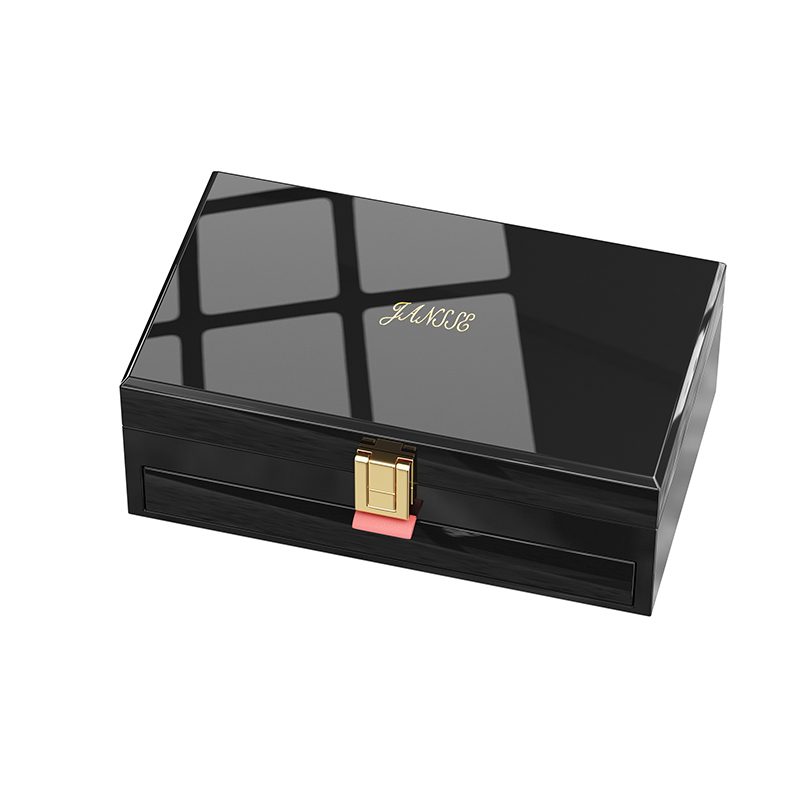
A packaging order is finished long before it is packed, and it is judged long after. The buyer who approved a beautiful sample sees the shipment once — when it lands — and by then every defect is a return, a reprint or a markdown. The gap between those two moments is quality control, and for wooden and leather boxes it is mostly a matter of knowing which surfaces to look at and when.
This guide sets out how a bulk order is actually built and inspected — the ten production steps, what is checked at each one, and the inspection you should run before the balance payment is released. It is written from the factory side, because that is where the decisions that determine quality are made.
Quality is a sequence, not a final inspection
Rigid boxes are not made in one operation. A wooden or leather-wrapped box passes through ten steps: cutting the board or solid wood, CNC shaping, fine sanding, primer, colour coat, controlled-temperature curing, polishing, hardware fitting, interior assembly, and inspection and packing. Each step is checked before the batch moves on.
That sequence matters to you as a buyer, because it defines where defects can be caught cheaply. A colour deviation found at the colour-coat stage costs a re-spray. The same deviation found at packing costs the whole batch. A box that has reached interior assembly has already absorbed every process before it, and no final inspection can undo them.
What machines do and what hands do
The first half of the sequence is precision work: cutting, shaping and surface consistency belong to machines, and a CNC-cut panel is identical to the one before it. The second half — wrapping leather corners, aligning wood grain across a lid and a base, setting a soft-close hinge — is done by hand, and this is where the sense of luxury comes from.
It is also where inspection has to be human. A grain mismatch is not a measurement error; a corner that has been wrapped a millimetre proud is not a tolerance failure. Both are visible to an experienced assembler and invisible to a gauge. Around 70% of the people on our production floor have worked together for more than ten years, which is the practical reason those judgements are consistent: the person assembling your order this month assembled the same format years ago.
Surface: the first thing anyone sees
Surfaces carry most of the perceived quality and most of the claims. On a high-gloss piano lacquer, check for orange peel, dust inclusions under the clear coat, and polish marks that only appear under a raking light. On a matte finish, check for sheen variation across panels — panels sprayed in different batches rarely match exactly, and the mismatch is obvious once two boxes sit side by side.
On wood veneer, check grain direction and colour match across the lid, body and any drawer fronts. On leather-wrapped bodies, check that the wrap is taut with no lifted edges, that corners are symmetrical, and that the grain pattern reads consistently from box to box. Curing under controlled temperature is what stops a finish from continuing to harden after packing — a box that was rushed through curing will mark in its own inner carton.
Structure: the things that fail in transit
Surface flaws annoy; structural flaws return. Check lid fit first — a lid should close with even resistance and sit flush on all four sides, with no rocking when the box is set down. Check hinges by opening and closing the lid through its full travel: a hinge that binds at one point will eventually tear out of its seat. Check closures by pulling, not by pressing: a magnetic catch that holds under finger pressure but releases under a lifted load is the single most common cause of damage in transit.
Check the corners of case formats and anything with a handle. Corner joints should take load rather than butt together, and a handle should be fixed into the frame with a plate behind the panel — not screwed through veneer, which pulls out.
Interior: where specifications drift
Interiors are specified loosely and inspected rarely, which is why they are the most common source of disappointment. Linings — velvet, suede, EVA, foam, moulded trays and watch pillows — should be checked for adhesion at the edges, cleanliness of the wrap, and consistency of colour across the batch. A lining that is a shade lighter on the last two hundred units is a visible problem when they are displayed together.
Then check fit, not appearance. Whatever the box is meant to hold should sit in its cavity without force and without rattle. A product held at one point in the middle will pivot in transit and mark the lining; it should be held at two points. Inserts cut to a drawing that was never verified against a real product are the classic failure here.
Branding: small area, high visibility
Branding occupies a few square centimetres and gets looked at first, so inspect it as a separate item. Hot foil should be fully transferred with no breaks in fine strokes. Laser marking should be even in depth, with no scorched halo on a natural or matte finish. Screen print should be registered, with no edge bleed. Debossing on leather should be crisp at the edges of the mark, not rounded off by a worn die.
Check position against the approved drawing, on every unit in the sample you pull — a drifting logo position is a jig problem, and it gets worse as the run continues, not better.
How to inspect a bulk order
There are three practical options, and most programmes use more than one. You can inspect on site before packing, appoint a third-party inspector to attend the pre-shipment check, or receive a pre-production sample plus a production sample and compare them against the approved specification. Third-party inspection is accepted as standard — inspectors from SGS and similar bodies attend regularly.
Whichever you choose, agree the acceptance criteria in writing before production: what counts as a critical defect, what counts as a minor one, how many units are pulled from a batch, and what happens if the result is borderline. Agreeing those numbers after a failed inspection is the expensive way to do it.
Packing, and the last mile
Export packing is part of the specification, not an afterthought. Standard packing is an inner paper box inside a five-layer export carton, and the carton specification should match the route: express and air freight punish insufficient corner protection, while FCL and LCL sea freight punish stacked load and moisture. Shipments go out EXW or FOB Guangzhou, by express, air or sea.
Ask what the carton drop-test or stacking result was if the route is long. A box that survives its own carton in a warehouse can still fail a container that sits in a humid port for three weeks.
Where inspection sits in the payment schedule
Standard terms are T/T with a 30% deposit and 70% before shipment, which means the natural inspection point is before the balance is released. That is the moment with the most leverage and the fewest options lost: the goods are packed, the specification is on file, and nothing has left the factory.
Production runs about 30 days after sample confirmation, so the pre-shipment inspection date should be booked when the sample is approved — not when the goods are reported ready. Inspectors need lead time, and a rushed inspection is usually a reduced one.
A pre-shipment checklist
| Check | What to look for |
|---|---|
| Surface finish | Orange peel, dust, sheen variation, grain match, lifted wrap edges |
| Lid and closure | Flush fit, even travel, no rocking; catch holds under lifted load |
| Hardware | Hinge leaf thickness and length as specified; handle fixed to frame |
| Interior | Lining adhesion and colour consistency across the batch; product held at two points |
| Branding | Complete transfer, even depth, correct position on every unit pulled |
| Dimensions | Outer size against the approved drawing; carton count and packing spec |
| Carton | Five-layer export carton, drop/stack suitability for the route |
If you want an inspection built into the programme rather than arranged at the end, say so when you request the quotation — the criteria then go into the specification, and the pre-shipment date is booked when the sample is approved. Custom programmes start at 500 pcs per design, with sampling in about 15 days including 3D digital proofing and two rounds of revision, and production in about 30 days. See custom packaging boxes for programme options, custom wooden boxes and custom leather boxes for the two bodies we build, and our service process for how a run is managed end to end.
Before the balance payment is released and the goods leave the factory. Standard terms are T/T with a 30% deposit and 70% before shipment, so the natural inspection point is pre-shipment — book the date when the sample is approved, because production runs about 30 days and inspectors need lead time.
Yes. Third-party inspectors, including SGS, attend pre-shipment checks regularly. Each of the ten production steps is also checked internally before a batch moves on, so defects are caught at the stage where they are cheapest to fix.
Surface issues — orange peel or dust in a lacquer, sheen variation between spray batches, wood grain mismatch across a lid and base — and structural issues such as a lid that rocks, a hinge that binds, or a magnetic catch that releases under a lifted load. Interior fit is the third: a product held at one point will pivot in transit and mark the lining.
The acceptance criteria in writing: what counts as a critical versus a minor defect, how many units are pulled from a batch, and what happens on a borderline result. Agreeing those numbers after a failed inspection is the expensive way to do it.