Perfume Box Design: Protecting Glass Bottles in Wooden and Leather Cases
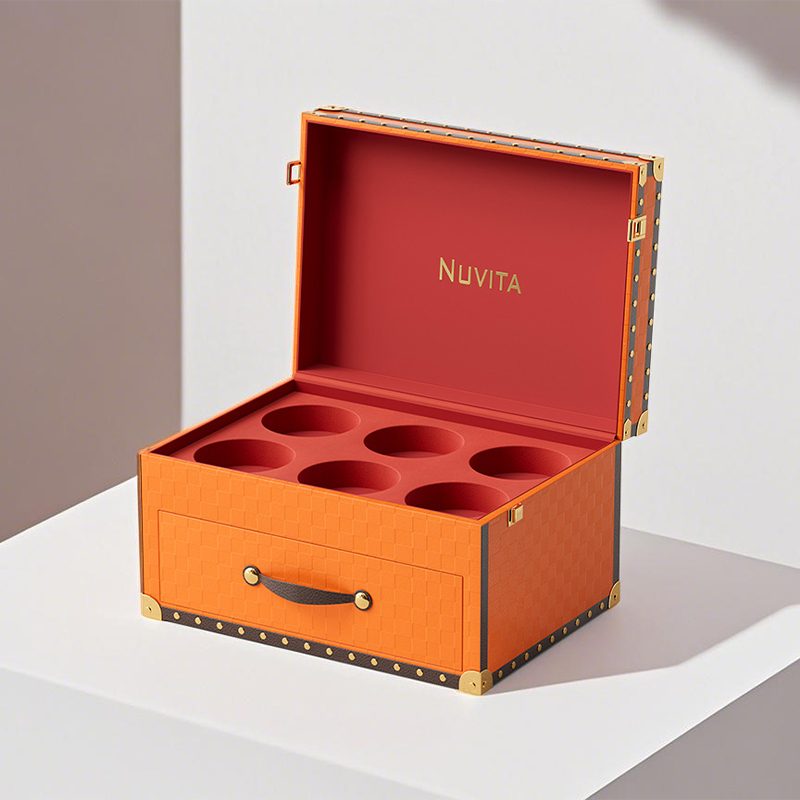
A perfume box has one job that outweighs every other: hand a glass bottle to someone intact. Everything else — the finish, the closure, the moment the lid lifts — only works if the bottle has not shifted, chipped or leaked in transit. That constraint is unusually tight. Glass is heavy for its volume, perfume is a hazardous liquid in several shipping classifications, and the box is usually expected to look like a gift rather than a container.
This guide covers how wooden and leather cases are built around a bottle: the insert that actually holds it, the formats for one, two and set presentations, and the specification decisions that decide whether a launch arrives in one piece.
Start from the bottle, not the box
Every dimension in a perfume box is derived from the bottle. Base diameter and footprint decide the cavity; shoulder height and cap diameter decide whether the bottle needs a collar; total height decides lid depth. A cap that is wider than the bottle body — which is most of them — means the cavity has a step in it, and that step has to be cut, not approximated.
Send a bottle drawing with base, body, cap and total height, and if the programme covers more than one size, say so at the start. A cavity cut for a 100 ml bottle will let a 50 ml bottle rattle; the usual answer is a removable collar or a two-part insert, and both have to be tooled at sampling, not added later.
The insert does the work
The box body gets the attention and the insert prevents the damage. Options range from EVA and shaped foam through velvet- and suede-wrapped mouldings to rigid moulded trays. EVA and foam are light and forgiving, and they are the usual choice for boxes that ship directly to a customer. Wrapped mouldings look better on a shelf and are the standard for gift sets. Rigid moulded trays hold their shape longest and suit a box that will be opened and closed for years.
Two rules apply regardless of material. The bottle should be held at the body and the neck, or seated on its base with a collar above it — never gripped at one point in the middle, where it can pivot. And the insert should support the bottle without pressing on the cap, because most caps are the weakest part and the first thing to crack under load.
One bottle: presentation formats
A single-bottle box is a presentation object and has three workable formats. An upright box seats the bottle in a base cavity with a neck collar and gives the smallest footprint and the best transit record. A slide-out box — the bottle lying in a drawer that pulls from a sleeve — reads as more ceremonial and is the classic format for a fragrance launch, but it needs a finger recess or a ribbon pull, and the drawer has to clear the sleeve without binding.
A lift-off lid box is the simplest to make and the most forgiving on tolerances, and it suits a bottle with an unusual silhouette that will not drop into a cavity cleanly. Where the bottle is heavy or top-heavy, upright wins; where the unboxing moment is the point, a slide-out or lift-off is worth the extra tooling.
Two bottles and gift sets
Once a box holds two or more bottles — a fragrance paired with a body lotion, or an eau de parfum with a travel size — the question is whether each item has its own cavity or shares a space behind a divider. Individual cavities are safer and cost more. A shared cavity with a removable divider is cheaper and lets one box take two different bottle shapes, which matters when the set contents change by season.
Height mismatch is the trap. A set with a tall bottle and a short jar looks balanced only if the insert steps down to meet both, and the lid has to clear the tallest item when it closes. Decide set contents before sampling: changing one item after tooling usually means a new insert, not a new hole in the old one.
Display pieces and unusual formats
Fragrance retail often calls for something that does not behave like a box at all — shaped display cabinets, multi-bottle presentation units, and cases that stay open on a counter rather than closing. These are built on the same substrate logic but with different priorities: visibility and stability on a counter, rather than protection in a carton.
For a display piece, plan for how it is cleaned and how it is lit. A high-gloss lacquer shows fingerprints and dust under retail lighting; a matte or open-grain wood hides both. Glass panels add weight and a safety consideration, and they should be specified as a material in their own right rather than as a window in a lid.
Wood or leather: how the body changes the box
A wooden body — solid, veneered or MDF with a lacquer — gives crisp edges, a flat surface for foil or laser marking, and high stacking strength. It is the usual choice for presentation boxes that sit on a shelf and for display units that carry weight. A leather-wrapped body gives a softer hand-feel, a better grip when carried, and a surface that hides the scuffs a case picks up in a warehouse, which is why it suits travel and carrier formats.
Leather-wrapped also moves the branding method: away from laser work and toward debossing or foil, and it adds weight and cost. Neither body is the premium option by default — the right one is the one that matches how the box will be handled.
Branding on a small surface
Fragrance branding is usually discreet and usually expensive to get wrong. On lacquered wood, hot foil gives the cleanest metallic result and holds fine strokes; laser marking suits a natural or matte finish; screen printing handles a multi-colour mark. On leather, debossing is the most durable and the most discreet, foil works on smooth grains, and a metal plaque set into the lid is the option when the mark has to read at a distance.
Keep the mark off the base and away from any fold. On a lid that opens, the mark should be positioned so it is upright when the box is opened toward the customer, not when it is stacked on a pallet.
Shipping glass: packing and route
Perfume is a liquid in glass, and several freight carriers apply their own rules to it, so the outer packing deserves the same attention as the box. Standard export packing is an inner paper box inside a five-layer export carton, and for glass the insert plus carton have to work as one system: a rigid insert in a loose carton still lets the box impact the carton wall.
Match the route to the value. Express and air freight suit launch quantities and high-value sets; sea freight suits replenishment volume and needs moisture and stacking consideration. Shipments go out EXW or FOB Guangzhou by express, air or sea.
What to send when you request a quote
| Field | Why it changes the quote |
|---|---|
| Bottle drawing: base, body, cap, total height | Sets cavity, collar and insert tooling |
| Format: upright, slide-out, lift-off or display | Changes panel sizes, lid depth and tooling |
| Number of items and their heights | Decides insert steps and lid clearance |
| Insert material and wrap | Changes protection, weight and unit cost |
| Body: wood, veneer or leather-wrapped | Changes surface process and branding method |
| Branding method and position | Decides whether a die or plaque is needed |
| Quantity and shipping route | Sets tooling split and carton specification |
Drawings are accepted in AI, C4D or PDF. Sampling takes about 15 days and includes 3D digital proofing plus two rounds of revision, so a decision made on screen is free and the same decision made after a physical sample costs three weeks. Custom programmes start at 500 pcs per design, and enquiries are answered within 24 hours.
See custom perfume boxes for fragrance formats, custom cosmetic boxes for sets and presentation packaging, and contact us to send a bottle drawing for quotation.
EVA or shaped foam for boxes that ship directly to a customer, velvet- or suede-wrapped mouldings for gift sets on a shelf, and rigid moulded trays for a box that will be opened for years. Whichever you choose, the bottle should be held at the body and neck — or seated on its base with a collar — never gripped at one point, and never pressed on the cap.
Yes, if it is specified that way from the start. A shared cavity with a removable divider lets one box take two bottle shapes, which is useful when set contents change by season. The divider has to be tooled at sampling — it cannot be added after the insert is cut.
Custom programmes start at 500 pcs per design. Sampling takes about 15 days and includes 3D digital proofing plus two rounds of revision, with production in about 30 days after sample confirmation.
Drawings are accepted in AI, C4D or PDF. Send base diameter, body diameter, cap diameter and total height for the bottle — a cap wider than the body means the cavity needs a step, and that has to be cut rather than approximated.