Travel Jewelry Cases: Choosing a Wood, Leather or PU Format for Rings, Necklaces and Sets
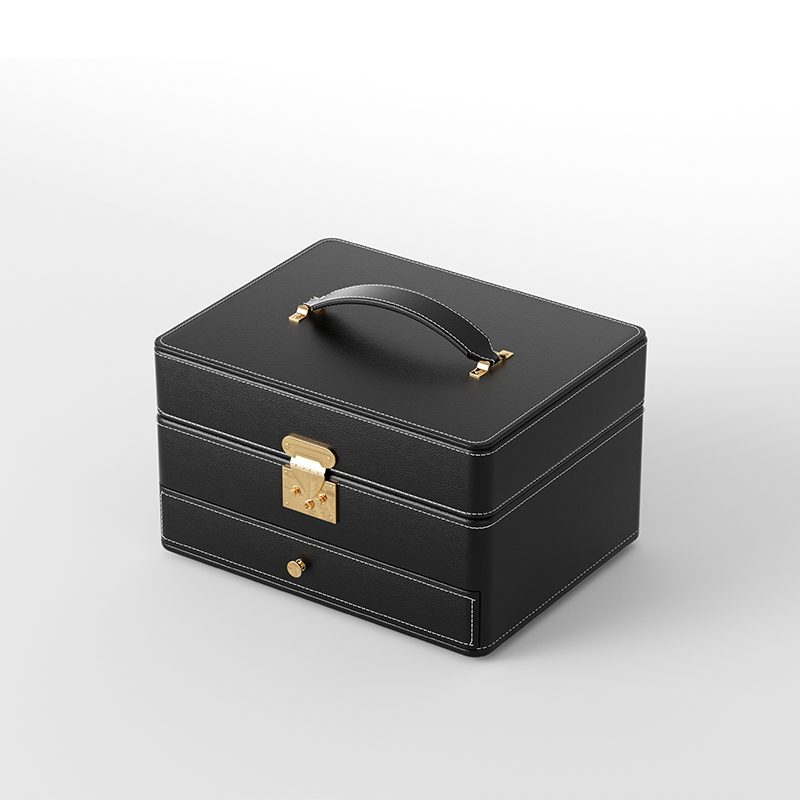
A jewelry box designed for a dressing table and one designed for a suitcase look similar and solve completely different problems. On a counter, nothing moves unless someone picks it up. In transit, the box is shaken, compressed inside other luggage, laid on its side, and opened by someone in a hurry in a hotel room. Every one of those conditions is predictable — and every one of them can be designed for.
This guide covers how portable jewelry packaging is put together: the three working formats, what actually holds rings, chains and earrings in place, how the choice of wood, leather or PU changes the result, and the specification details to settle before a custom programme goes to sampling.
The travel problem: what actually fails on the move
Three things break portable jewelry packaging, and none of them is the hinge. The first is movement inside the box: anything with clearance will travel, and anything that travels will either tangle or abrade. The second is compression from outside — a case in a packed bag takes load it will never see on a shelf. The third is the closure letting go, which is usually discovered after the contents have already moved.
So the brief is not "the same box, smaller". It is a box whose interior holds every item at rest, whose body resists being squeezed, and whose closure stays shut under a pull rather than just a press.
Case, roll or pouch: three formats and what each is for
A case has a rigid or semi-rigid body with a structured interior — ring bars or tabs, a small pouch or panel for drops, maybe a shallow tray. It offers the most protection and the most organisation, and it is the format to choose when the contents are valuable or the itinerary rough.
A roll is a flat panel with storage panels and ties that rolls up and closes with a strap or snap. It packs flatter than anything else and suits soft or short pieces, but it gives almost no crush protection and it puts everything into one layer — which means adjacent items touch.
A pouch is the lightest and least structured. It works for a single category — earrings, a bracelet — or as a liner inside a larger case, and it is rarely the right answer on its own for a mixed set. A fourth option, and often the best for a premium programme, is a small rigid case that borrows the language of a full chest: a hinged lid, a tray, and a footprint sized for travel rather than for a counter.
Rings: bands, tabs and removable panels
Rings are easy to hold and easy to hold badly. A padded roll or a slotted bar is the standard because it grips the band along its length rather than gripping nothing at the top. The critical dimension is the depth of the slot relative to the widest ring in the range: too shallow and the ring lifts out the moment the case is inverted; too tight and a wide band will score the surrounding material.
Decide early whether the case covers one ring or a set. A removable panel — a short bar that lifts out of the case — lets a travel format serve both, and it has to be tooled at sampling, because cutting it in later means rebuilding the base it sits in.
Chains and pendants: managing length without tangles
Chains are the reason most travel cases fail. Laid loose in a compartment, four necklaces become one knot, and separating them is the kind of experience a customer remembers. The workable answers are all variations on separating and anchoring: a strap or tab that holds each chain by its clasp end with the length hanging free below, a hook bar that lets each piece hang vertically, or a recessed channel for each chain covered by a soft flap.
Whichever you specify, leave the hang length generous and the lining low-friction. Suede and velvet read as premium and grip less than most alternatives; a stiff synthetic lining will hold a fine chain in place by friction and kink it.
Earrings and small pieces: the items that go missing
Earrings, studs, cuffs and small charms are lost rather than damaged, and they are lost in two specific places — in the gap beside a tray, and inside the lining itself. Give small pieces a bounded volume: a covered pocket, a perforated panel that takes studs through the card they are sold on, or a shallow tray with a lid or flap of its own.
Avoid open compartments with a lip lower than the item height, and avoid relying on a lining pocket with no backing panel. If the case will be opened on a tray table rather than a table, every compartment should keep its contents when the case is tilted thirty degrees.
Body material: wood, leather-wrapped or PU
A wood body — solid, veneered or MDF under a lacquer — is the stiffest option and the best at resisting the compression of a packed bag. Its cost is weight and hardness: it transmits impact rather than absorbing it, and it shows its own scuffs. A high-gloss lacquer is also unforgiving in a travel context, where fingerprints and dust arrive immediately; a matte or open-grain finish hides far more.
A leather-wrapped body over a rigid substrate gives grip in the hand, absorbs minor impact, and hides the scuffs a case picks up over a year of use. It costs slightly more thickness and it moves the branding method away from laser work toward foil or debossing. PU gives the same look at lower material cost and usually a more uniform surface, which matters when a programme reorders.
Appearance alone does not tell you which material you have. Specify the wrap explicitly — genuine leather, PU or another alternative — in the specification, and ask for a material declaration with the sample. It is the only way to know what you will be re-ordering in eighteen months.
Interiors, closures and hardware
Interiors should be specified as materials with a stated colour reference, not as adjectives. Velvet, suede, EVA, foam and moulded trays behave differently: wrapped foam and moulded trays hold shape and position, EVA absorbs vibration, velvet and suede protect a polished surface best. Colour consistency across a batch matters more on a small case than a large one, because there is nowhere for a mismatch to hide.
For closures, judge by pulling, not pressing. A magnetic catch that holds when you press the lid and releases when the case is lifted by its corner is the single most common failure in portable formats. A zip should have a smooth run and a garage or keeper at the end so the pull does not rattle against the body. Any handle should be fixed into a frame or a backed plate rather than screwed through a veneered panel, which pulls out.
Branding a small portable piece
Branding area shrinks with the format, so the method has to be chosen against the surface. Hot foil gives the cleanest metallic result on lacquered wood and on smooth leather or PU. Laser marking suits natural or matte wood. Debossing is the most durable mark on leather and the most discreet. Screen printing handles more than one colour on a flat ground.
Keep the mark away from any fold, strap anchor or zip line, and position it so it reads upright when the case is opened toward its owner — not when it is stacked on a pallet. On small portable pieces a metal plaque is often a better answer than a print, because it survives being carried.
How to brief a travel jewelry case
| Field | Why it changes the build |
|---|---|
| Contents: item types, count, largest and smallest dimensions | Sets compartment count, panel depth and hang length |
| Format: case, roll, pouch or mini chest | Decides substrate, tooling and protection level |
| Body material and finish | Weight, crush resistance, branding method, cost |
| Interior material and colour reference | Friction against chains, colour consistency on reorder |
| Closure and hardware specification | Whether the case stays shut under a lifted load |
| Branding method and position | Whether a die or plaque is needed |
| Quantity, route and target date | Tooling split, carton specification, calendar |
Drawings are accepted in AI, C4D or PDF. Sampling runs about 15 days and includes 3D digital proofing plus two rounds of revision, so the cheap place to change a slot depth is on screen, before anything is cut. Custom programmes start at 500 pcs per design, with production in about 30 days after sample confirmation; enquiries are answered within 24 hours.
See custom jewelry boxes for the full range of formats, custom leather boxes for wrapped bodies and soft formats, custom wooden boxes for rigid lacquered and veneered bodies, and contact us to send a contents list for quotation.
A rigid case with a structured interior. A roll packs flatter but puts everything in one layer with no crush protection, and a pouch suits a single category or a liner inside a case rather than a mixed set. Whatever the format, the test is simple: tilt it thirty degrees and nothing should move.
Yes, if each category has its own bounded volume — a padded bar or removable panel for rings, tabs or hook positions that separate chains, and a covered panel or pocket for studs and small pieces. Bounded volumes are what stop items migrating into gaps or into the lining.
Wood is stiffest and resists compression best but is heavier and shows its own scuffs. A leather-wrapped body grips well, absorbs minor impact and hides wear, and moves branding to foil or debossing. PU gives a similar look with a more uniform surface, which helps on reorders. Specify the material by name and ask for a declaration rather than judging by appearance.
Custom programmes start at 500 pcs per design. Sampling takes about 15 days and includes 3D digital proofing plus two rounds of revision, with production in about 30 days after sample confirmation. Drawings are accepted in AI, C4D or PDF, and enquiries are answered within 24 hours.