Watch Box Interiors: Pillows, Cushions and Slot Layouts Explained
Ask a collector what they think of a watch box and they will rarely talk about the wood first. They will talk about whether the pillow held the strap without strain, whether the lining shed fibers onto a cream dial, whether the tenth slot actually fits a watch on a bracelet. The interior is where a watch box succeeds or fails in daily use — and it is the part most often left vague in purchase orders. This guide breaks down the three building blocks of a watch box interior — pillows, cushions and slot layouts — so you can specify them with confidence instead of leaving them to chance.
Watch Pillows: The Default, and How to Get Them Right
The watch pillow is the standard solution for single-slot lids and collector cases alike: a curved cushion that holds the watch head while the strap wraps underneath, keeping the dial presented toward the viewer. In our stock designs, pillows are upholstered in suede or velvet over a resilient foam core — soft enough to protect the caseback and strap, firm enough that the watch does not slump after weeks of storage.
Two details separate a good pillow from an afterthought. First, firmness: a pillow that is too soft lets smaller-dressed watches sink and tilt; too firm, and it forces sport watches on bracelets to sit proud of the slot. Second, cover material: suede and velvet behave differently against polished cases. Suede has a slightly tighter nap and reads more tailored; velvet is plusher and reads more boutique. Neither is wrong — but mixing them randomly across a product line makes a brand look unconsidered.
Fixed Slots vs Removable Cushions
Once you move beyond single boxes, the layout question becomes structural: do the dividers and pillows stay fixed, or can the owner reconfigure the space?
Fixed layouts look tidier and keep every watch evenly spaced — the right choice when the slot count is tuned to a specific collection, such as a branded presentation case that will always hold the same number of references.
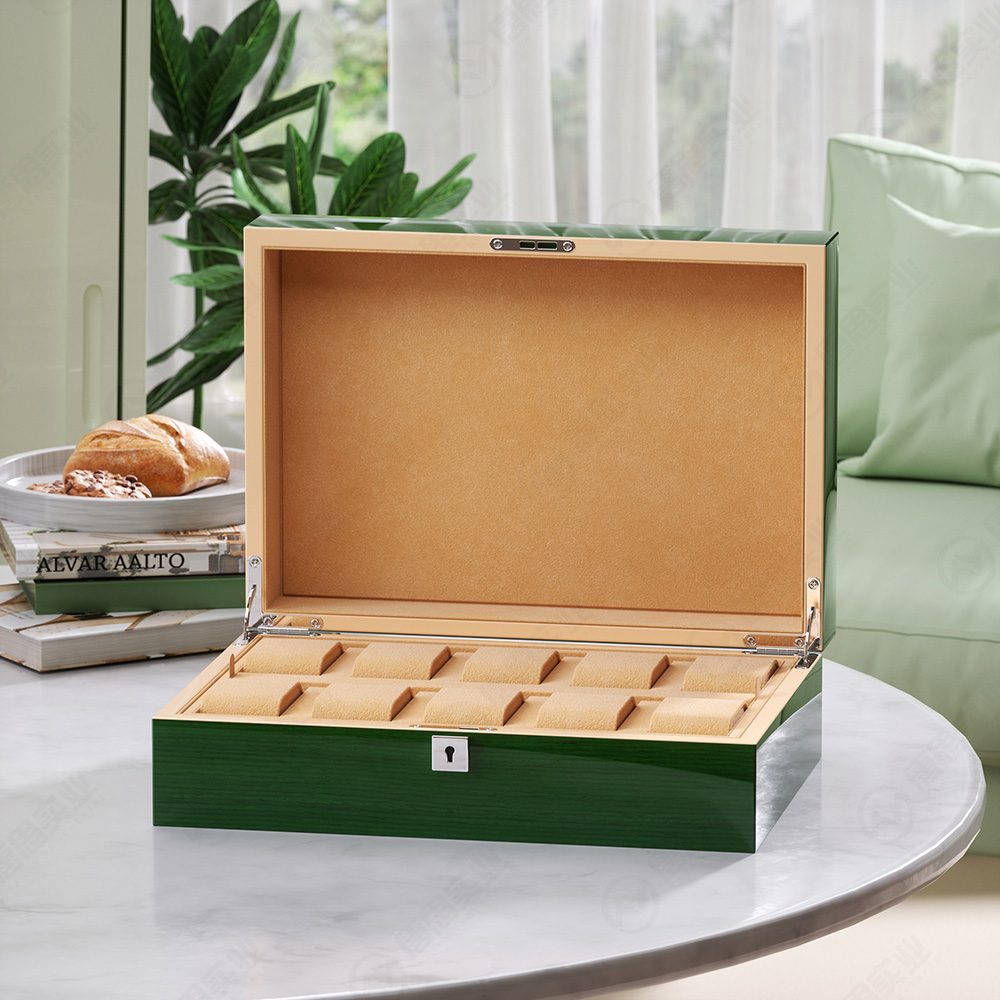
Removable cushions trade a little of that symmetry for real flexibility. Our green ten-slot collector case, for example, ships with cushions that lift out, so the owner can convert two adjacent slots into a wider bay for a dive watch on a bracelet, or remove a row entirely to store documents or an extra strap. For retailers and gift buyers, that adaptability noticeably widens the pool of end customers a single design can serve.
Slot Layout Families: From Single Lids to Twelve-Position Cases
Across our 100+ ready-to-ship designs, watch box interiors fall into a handful of proven layout families:
| Layout family | Typical capacity | Best suited for |
|---|---|---|
| Single-slot lid box | 1 watch | Boutique presentation, gift-with-purchase, brand flagships |
| Double / triple slot lid box | 2–3 watches | Retail shelf boxes, personal duos and trios |
| Fold-out double-door case | 3 watches | Compact travel and drawer storage |
| Collector case | 10+ watches | Enthusiasts, brand archives, VIP gifts |
| Aluminum frame case | ~12 watches | Trade shows, high-count storage with glass-lid display |
One warning from experience: do not treat slot count as a purely geometric calculation. A "12-slot" case built without accounting for bracelet thickness and crown height becomes a case of twelve watches that touch each other. Real watches — with their straps wrapped, buckles tucked and crowns accounted for — need more room per slot than the watch head alone suggests.
Travel Interiors: Rolls and Zippered Cases
Travel storage inverts the priorities of the display box. Here the interior must secure watches against movement, not just present them. Cylindrical watch rolls — available in one, two and three-slot configurations in our stock range — wrap each watch in its own suede-lined channel and rely on a snap closure to keep everything compressed. Zippered leather cases add a full-perimeter closure for the same purpose at higher capacities.
The interior detail that matters most in travel formats is retention: each channel should hold the watch head firmly enough that shaking the closed roll produces no audible movement. That is a spec worth writing down, because it is the first thing an end customer tests.
Lining Materials: Suede, Velvet, EVA and Foam
Beneath the pillows, every interior surface the watch touches should be a textile. In our stock lines, wooden lacquer boxes are typically lined with suede or velvet in colors matched to the exterior — beige suede inside the green lacquer case, grey suede inside the matte black box. Aluminum frame cases use black velvet cushions against the metal structure.
Under the fabric sits the structural layer: EVA or foam, cut to shape. The fabric choice drives perception; the foam choice drives longevity. An insert cut with too sharp an edge will, over months, print its outline through thin velvet. We covered the jewelry-side version of this topic in detail in our jewelry box inserts guide — the same logic applies to watch packaging, with the added constraint that watch pillows carry real weight.
A Specification Checklist to Send Your Manufacturer
Before you approve a watch box project, make sure the interior is specified, not implied:
- Slot count and layout family — single, multi-slot, collector case or travel format
- Pillow style — fixed or removable, and the retention behavior when the closed box is shaken
- Lining material and color — suede vs velvet, matched or contrasted to the exterior finish
- Fabric coverage — every surface the watch can contact, including divider tops and the underside of the lid
- Clearance assumptions — bracelet-on or strap-wrapped storage, crown height, extra-link allowance
Sending these five lines with your request removes most of the back-and-forth in sampling — and most of the risk that the finished box looks premium but lives badly.
How We Build and Verify Interiors
Interiors are fitted late in our production flow — after woodworking, lacquering and hardware — which means they inherit every upstream tolerance. Sampling takes about 15 days and includes 3D digital proofing plus two rounds of revisions, which is where pillow fit and slot spacing get tuned against your actual watches. Mass production takes about 30 days, with each process inspected before moving to the next, and third-party inspection is welcome. We hold ISO 9001, FSC, CE, RoHS and REACH certifications, and we have been manufacturing wooden and leather packaging in Guangzhou for 18 years, serving more than 3,700 brands.
If you want to feel the differences described here before committing to a custom run, browse our in-stock watch boxes under the Tancy brand — stock designs start from 50 units, and every layout family above is represented. When you are ready for your own layout, start from our custom watch boxes page, or send your checklist directly through our contact page and we will respond within 24 hours.
The main families are single-slot lid boxes, double and triple-slot boxes, fold-out travel cases, 10+ slot collector cases and aluminum frame display cases. Within any of them you can choose fixed dividers or removable cushions, and specify pillow style, lining material and color.
Yes. Pillows are upholstered in suede or velvet over a shaped foam core, sized so the strap wraps naturally and the dial faces upward. For travel formats such as watch rolls and zippered cases, each channel is designed to retain the watch firmly — a closed roll should be silent when shaken.
In designs with removable cushions, yes — our stock collector cases ship with lift-out cushions so owners can widen a slot for a bracelet watch or free up space for straps and documents. Fixed layouts are also available where even presentation matters more than flexibility.
Yes. Lining color and material are part of the custom specification from 500 pcs per design. If you want to test a design first, our 100+ ready-to-ship Tancy designs start from 50 units and cover the full range of interior layouts.