Watch Box Sizing: Slot Pitch, Cuff Clearance and Case Diameter
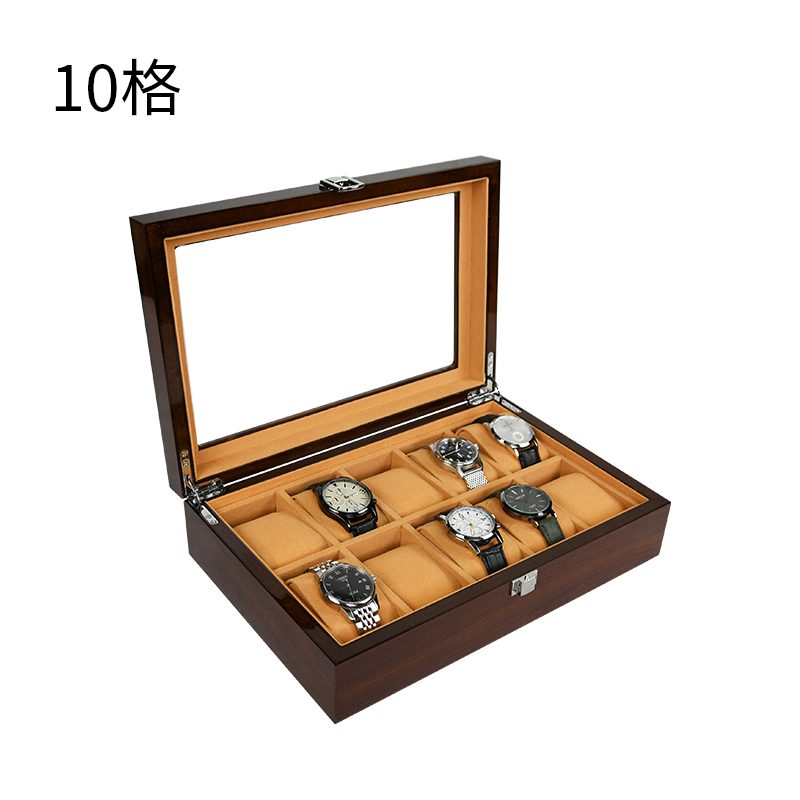
Almost every watch box specification starts with a slot count and stops there. That is the number buyers remember and the one that causes the most rework, because slot count says nothing about whether the watches actually fit. What decides fit are three measurements: case diameter, cuff or bracelet height, and the pitch between slots. Get those right and a ten-slot box holds ten watches. Get them wrong and it holds eight, or it holds ten with the lids resting on the crystals.
This guide walks through how a watch box is sized, from the single-watch presentation box up to a 48-slot collector case, and what to send a factory so the first sample is the right one.
Start with the largest watch, not the average
A box sized around an average watch fails the moment a larger one goes into it. The measurement that matters is the largest case diameter in the collection the box has to hold — and for most programmes that is a chronograph or a dive watch in the 42–46 mm range, not the 38 mm dress watch in the product photo.
Specify a maximum, not a typical value. "Must accept cases up to 46 mm" is a usable instruction. "Around 40 mm" is not, because it leaves the factory to guess which side of 40 mm to err on, and the safe guess is a larger slot that lets smaller watches rattle.
Case diameter sets the slot width
Slot width is case diameter plus clearance. Too little clearance and the watch has to be forced in, which scuffs the case side and, over time, wears the lining. Too much and the watch slides and knocks its neighbour. In practice a few millimetres of clearance is enough, and the pillow inside the slot does most of the holding.
Case diameter also drives the outer footprint. Ten slots at 46 mm pitch is a materially wider box than ten slots at 38 mm pitch, and that difference shows up in panel size, lid stiffness, hinge specification and shipping cost. Boxes are quoted on size before they are quoted on slot count.
Bracelet height is the dimension everyone forgets
A watch lying in a slot occupies more height than its case diameter suggests. The case back sits in the pillow and the bracelet or strap wraps around it, and the whole assembly stands proud of the slot by however thick that wrap is. A metal bracelet on a full-sized dive watch adds considerably more height than a flat leather strap.
That is the dimension that decides lid depth, and it is the one most specifications omit. If the box has to hold bracelet watches, say so and give the height of the watch as it will be stored — wrapped, not laid flat. A lid that closes over leather straps will press on a bracelet clasp.
Pillows: what holds the watch
The pillow is the working part of a watch slot. It keeps the bracelet closed so the watch does not rattle, it supports the case back, and it presents the dial at the angle the box was designed around. Pillows are usually wrapped in the same material as the lining — velvet or suede over foam — and they are sized to the slot, not to the watch.
Two specifications matter: pillow diameter and pillow firmness. A pillow that is too firm for a small bracelet will not let the watch seat, and one that is too soft will not hold a heavy watch in place. If the box has to take both small and large watches, removable or interchangeable pillows are usually the answer, and they have to be specified before sampling.
Slot pitch and lid clearance
Pitch — the centre-to-centre distance between slots — is where capacity is really decided. Increasing pitch by a few millimetres can push a twelve-slot box into the footprint of a fifteen-slot one, or force a row to be dropped. Pitch also determines how much material sits between slots, which is what keeps the box rigid and stops the dividers from flexing when watches are lifted out.
Lid clearance is the vertical counterpart. A glass-top box needs enough depth for the lid glass to clear the tallest watch without touching; a solid lid needs enough to close without pressing. Both are cheap to fix on a drawing and expensive to fix on a finished box.
Formats: what each size range is for
Small formats — a single presentation box, or a two- or three-watch travel roll — are gifts and personal items. They are sized around one watch and one strap, and they are usually the most forgiving to specify. Mid-size formats — six, eight, ten or twelve slots — are the collector boxes that sit on a dresser or in a drawer, and they are where sizing mistakes are most visible, because every slot is occupied and any mismatch repeats across the row.
Large formats — fifteen slots and up to forty-eight — are storage furniture. At that size the box has to be designed as a cabinet: drawer runners instead of lift-out trays, a frame that takes the weight, and a lid or door that does not sag. Double-door and drawer formats both exist for this reason, and the choice is about where the box will sit and how often it is opened.
Display trays versus storage boxes
A display tray shows watches without storing them safely. It is open, it is shallow, and it assumes the watches stay put — which suits a counter or a showcase and does not suit a drawer that gets pulled out. A storage box closes and protects.
The distinction matters for sizing because a display tray can be built to the watch alone, with no lid depth to allow for, while a storage box has to accommodate everything above the case back. Buyers sometimes order a display format and then use it for storage, which is how watches end up dusty and knocked together.
Interior materials and what they cost you
Linings for watch boxes run from velvet and suede through EVA and foam to moulded inserts and removable cushions. Velvet and suede are the presentation standard and show wear at the points where a bracelet rests. EVA and foam are more forgiving and better suited to travel formats. Moulded inserts hold shape longest and suit boxes that are opened every day.
Specify the lining by use, not by photograph. A lining chosen for how it looks in a product shot is often the one that shows a bracelet mark within a season.
What to send when you ask for a quote
| Field | Why it changes the quote |
|---|---|
| Maximum case diameter | Sets slot width, pitch and outer footprint |
| Storage height (watch wrapped, bracelet or strap) | Sets lid depth; the most commonly omitted dimension |
| Slot count and format (box, drawer, tray, roll) | Decides panel sizes, runners and frame specification |
| Pillow type: fixed or removable | Changes insert tooling and whether one box fits mixed sizes |
| Lining material and colour | Affects wear behaviour, cost and colour-matching across a batch |
| Body and finish | Changes surface process and branding method |
| Quantity: in-stock or custom | Sets whether existing tooling can be used |
If the format you need is close to something already in production, the ready-to-ship range is worth checking first: over 100 designs are held in stock and go out from 50 units per design, which is often the fastest way to test a market before committing to a custom run. Custom programmes start at 500 pcs per design, with sampling in about 15 days including 3D digital proofing and two rounds of revision, and production in about 30 days after confirmation.
Send the largest watch dimensions and the slot count and you will have a format recommendation and a quotation within 24 hours. See custom watch boxes for bespoke programmes, in-stock watch boxes for existing formats, and contact us to start a specification.
Maximum case diameter, the height of the watch as stored (bracelet or strap wrapped around the pillow), and the slot count. Storage height is the one most specifications omit, and it is what decides lid depth.
Yes, if capacity is specified with a maximum case diameter and removable or interchangeable pillows are included. A box built around 38 mm cases will not take a 46 mm chronograph — size the slot pitch from the largest watch, not the average.
A display tray is open and shallow — it presents watches but does not protect them, and it suits a counter or showcase. A storage box closes, needs lid depth above the tallest watch, and protects the contents. Ordering a display format for storage use is the common mistake.
Custom programmes start at 500 pcs per design, with sampling in about 15 days including 3D digital proofing and two rounds of revision, and production in about 30 days. Ready-to-ship designs start from 50 units per design across more than 100 held in stock.