Watch Travel Rolls and Cases: Choosing a Leather Format for 2 to 10 Watches
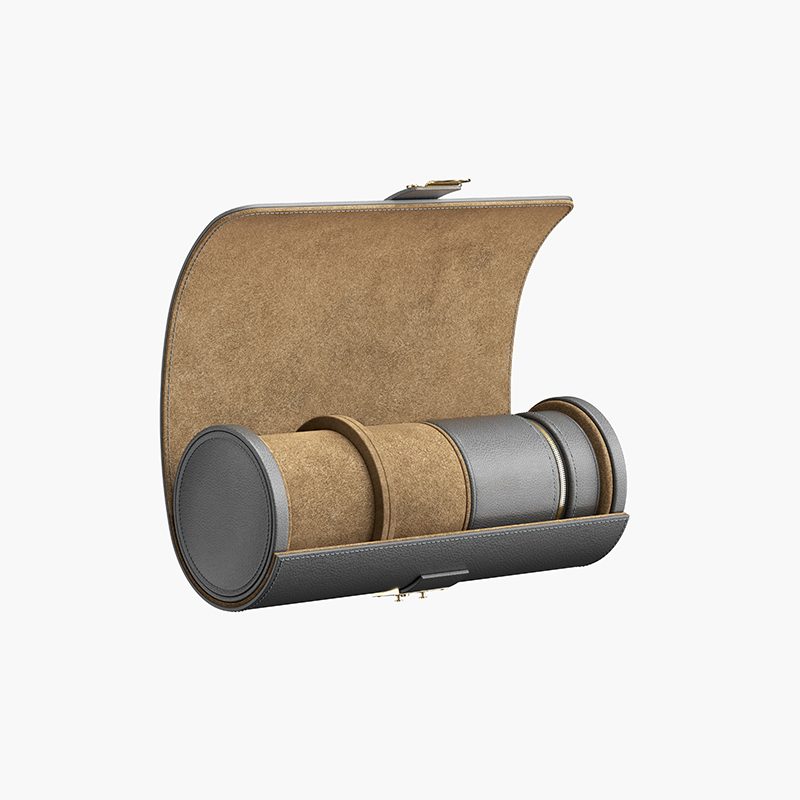
A watch box for the home is a piece of furniture: it sits still, it shows the watches, and it is opened in a good light. A travel format has the opposite job. It gets closed, packed, dropped into a bag, carried through an airport and opened in a hotel room — and it has to deliver the watch in the same condition it left. That difference drives every choice below.
This guide covers the three leather formats that work for travel — the roll, the zip case and the hard case — and the specification points that decide whether the finished item protects the watch or merely looks like it does.
Where a travel format sits next to a display box
Most watch programmes need two things, not one: a display box that lives on a dresser or in a showroom, and a travel format that leaves the house. They are not substitutes. A display box has a rigid body, a glass or solid lid and a fixed slot layout; a travel format has to be lighter, softer at the edges, and able to absorb a knock without passing it to the watch.
If you are specifying both, treat them as two projects with a shared visual language — same leather, same stitch, same mark — rather than one box in two sizes. The construction is genuinely different.
Roll, zip case or hard case
A roll is the lightest and the most compact: a length of leather or wrapped substrate that wraps around cylindrical pillows and closes with a strap or snap. It packs flat, weighs little and suits one to four watches. Its weakness is crush resistance — a roll in a packed suitcase transfers pressure directly to the pillows.
A zip case adds a semi-rigid shell around the pillows, usually with a moulded or padded interior, and closes with a zip that runs around three sides. It holds four to ten watches, keeps dust out, and takes a knock far better than a roll. It is the most common choice for a brand that ships to customers.
A hard case — a rigid body wrapped in leather, with a handle or a solid frame — is the most protective and the heaviest. It suits ten watches and up, or any programme where the case itself is the premium object, such as a collector's travel briefcase.
Capacity: how many watches, and how big
Capacity is not just a number of slots; it is a number of slots at a given watch size. A six-watch roll built around 38 mm cases will not close properly over two 44 mm chronographs with bracelets. Specify capacity together with the largest case diameter and the thickest watch the format must accept.
Two practical rules come out of sampling: leave clearance between adjacent pillows for the bracelet or strap to sit, and size the slot pitch — the distance from pillow centre to pillow centre — from the widest watch, not the average. A format that fits nine out of ten watches is a format that gets returned.
Pillows, cushions and bracelet clearance
The pillow is the part that touches the watch. Too soft and the watch sinks and rubs; too hard and a bracelet cannot wrap around it, so the case will not close. A firm core with a slight give in the wrap is the usual answer, and the wrap should be a low-lint material — suede or microfibre — rather than a shiny fabric that marks polished case backs.
Bracelet clearance is the most common sampling failure. A metal bracelet that is not fully closed adds volume, and a leather strap adds bulk at the buckle. Ask for the pillow to be tested with the watch's own bracelet in its shipped position, not folded flat.
Leather: genuine or PU
Genuine leather brings a natural grain, a softer break-in and a surface that ages. PU brings colour consistency across a large run, a uniform grain and easier cleaning — and it is the more predictable choice when a brand needs an exact Pantone match over several production runs.
Both are wrapped over a substrate, so both can be built on the same structure. The decision is usually made on three things: the target hand-feel, the colour-matching requirement, and whether the brand's own material policy already rules one out.
Linings: suede, velvet and microfibre
The lining does the quiet work. Suede — genuine or synthetic — is the standard for watch formats: it holds the watch in place without slipping and does not shed. Velvet reads more luxurious and shows fewer marks in a showroom, but it holds dust in a travel case. Microfibre is the practical option for a format that will be used hard.
Match lining colour to the watches rather than to the leather. A dark lining hides wear; a light lining shows off a steel case but will mark within weeks of real travel.
Closures: zip, snap, buckle or wrap strap
On a roll, the choice is between a wrap strap with a snap and a buckle. A snap is faster and cheaper; a buckle is adjustable, which matters if the same roll has to hold two and four watches. On a zip case, specify the zip by tooth size and tape, and ask for a branded puller — it is the single cheapest place to put a mark on the item.
Zips are the most common warranty claim in travel formats, and almost every failure is a zip that was specified too fine for the load. On a ten-watch case, the zip is carrying real tension around a curve.
Branding on leather
Debossing — pressing the mark into the surface with heat and a die — is the most durable and the most discreet option on both genuine leather and PU, and it costs nothing per unit once the die exists. Foil stamping gives a metallic result and works best on smooth grains. Embroidery suits a fabric lining or a strap. Laser marking is possible on PU but tends to look like a burn on genuine leather.
Put the mark where it will be seen when the case is opened, and keep it off the zip line and away from the fold on a roll — a mark across a fold will crack within a season.
What buyers get wrong before sampling
Three mistakes account for most second samples. The first is specifying capacity without a maximum case size. The second is choosing the lining for how it looks in a photo rather than how it survives a suitcase. The third is ordering a travel format and then judging it against a display box — a travel case is supposed to be lighter and softer, and if it is as rigid as a display box it will be too heavy to carry.
None of these are manufacturing problems. They are specification problems, and they are all solvable on paper before the first sample is cut.
A short checklist before you request a quote
| Field | Why it changes the quote |
|---|---|
| Format: roll, zip case or hard case | Decides substrate, shell tooling and weight |
| Capacity and largest watch size | Sets pillow diameter and slot pitch |
| Leather: genuine or PU, grain, colour standard | Affects sourcing and colour-matching cost |
| Lining material and colour | Changes wear behaviour and perceived quality |
| Closure hardware and zip specification | Long lead items; failures here are expensive |
| Branding method and position | Decides whether a die is needed |
| Quantity: in-stock or custom | Sets whether existing tooling can be used |
If the format you need is close to something already in production, the ready-to-ship range is worth checking first: over 100 designs are held in stock and go out from 50 units per design, which is often the fastest way to test a market before committing to a custom run. Custom programmes start at 500 pcs per design, with sampling in about 15 days including 3D digital proofing and two rounds of revision, and production in about 30 days after confirmation.
Send the watch sizes, the capacity and a reference image and you will have a format recommendation and a quotation within 24 hours. See in-stock watch boxes for existing formats, custom watch boxes for bespoke programmes, and contact us to start a specification.
A roll wraps around cylindrical pillows and closes with a strap or snap — it is the lightest and most compact option, best for one to four watches. A zip case adds a semi-rigid shell around the pillows and closes with a zip, holding four to ten watches with far better crush resistance.
Only if capacity is specified with a maximum case diameter and thickness. A six-watch roll built around 38 mm cases will not close over two 44 mm chronographs — size the slot pitch from the widest watch, not the average.
Ready-to-ship designs start from 50 units per design, with over 100 designs held in stock. Custom formats — your own leather, colour, lining and branding — start at 500 pcs per design.
Debossing. The mark is pressed into the surface with heat and a die, so there is nothing to wear off, and it works on both genuine leather and PU. Foil suits smooth grains; a mark placed across a fold will crack within a season on any method.