Wine Boxes: Choosing a Structure for One, Two or Six Bottles
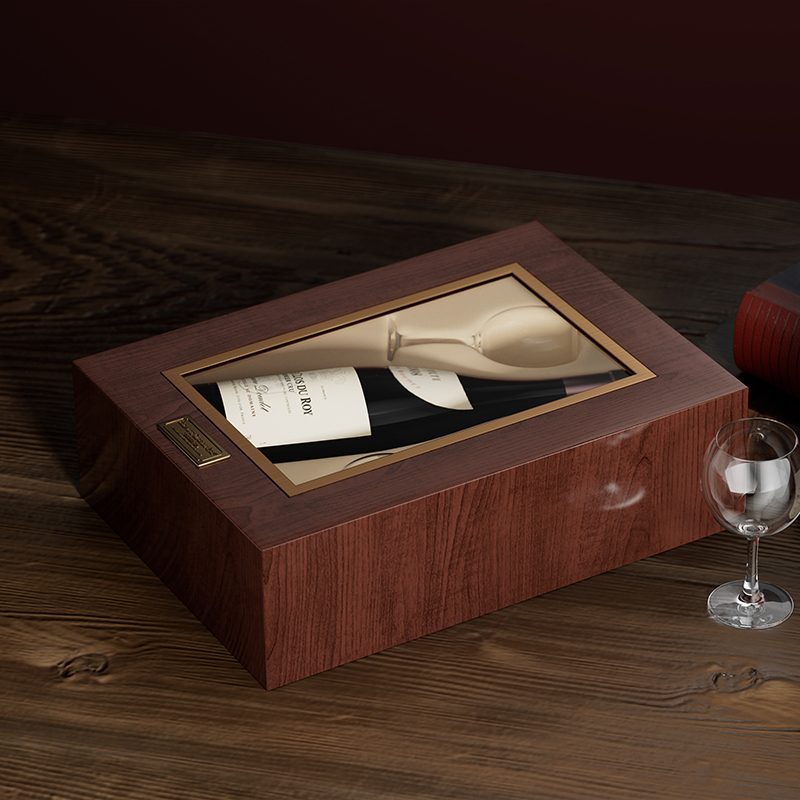
A wine box looks like a styling decision and behaves like a structural one. Before anyone talks about veneer, stitching or a foil logo, four numbers decide the box: how many bottles it holds, what shape the bottles are, how the box opens, and how far it has to travel. Get those four right and the rest of the specification settles quickly. Get one wrong and you are back to a second sample round, three weeks later.
This guide walks through the structure choices in the order a factory needs them, from bottle count through to the brief you send for quotation. It is written for wooden and leather-wrapped boxes — the two bodies that hold a bottle safely and survive being carried.
Why bottle count comes first
Bottle count sets the footprint, the weight and the internal geometry all at once. A one-bottle box is a presentation object: it sits on a table, opens toward the guest and frames a single bottle. A two-bottle box is usually a gift pairing — a red and a white, a bottle and two glasses. A six-bottle box is closer to a case: it gets carried, stacked and shipped, and its corners and closures take real load.
Decide the count before anything else, because every later choice inherits it. Changing from one bottle to two after sampling does not add an insert — it changes the panel sizes, the hinge specification, the insert tooling and the outer carton.
Bottle shape matters more than bottle count
Two "standard" bottles are rarely the same shape. A Bordeaux bottle has high, straight shoulders and a long neck; a Burgundy bottle slopes gently from a wider body; a Champagne bottle has a deep punt and a wider base. The difference is only a few millimetres in the shoulder, but it is exactly the few millimetres that decide whether a bottle drops into a cavity cleanly or jams against the divider.
Send the actual bottle — or a drawing with base diameter, body diameter, shoulder height and total height — when you request a quotation. If the box has to accept more than one shape, say so at the start: a cavity cut generously enough for a Champagne base will let a Bordeaux bottle rattle, and the fix is a removable collar, not a bigger hole.
One bottle: vertical, horizontal or angled
A single-bottle box has three workable presentations. Upright presentation is the most compact and the most stable in transit — the bottle stands in a fitted base cavity with a neck collar above it. Horizontal presentation reads as more ceremonial and is the classic gift-box look, but it needs a longer footprint and a cradle that supports the bottle along its length rather than at two points. Angled presentation looks striking on a shelf but is the least forgiving to manufacture, because the cradle has to be cut at a compound angle and the closure has to hold a bottle that wants to slide.
For most programmes, upright wins on cost and damage rate, and horizontal wins on shelf presence. Angled is worth it only when the box is a display piece that will not travel far.
Two and three bottles: dividers, shared cavities and glass sets
Once a box holds more than one bottle, the question becomes whether each bottle has its own cavity or shares a space with a divider. Individual cavities are safer and more expensive; a shared cavity with a removable wooden divider is cheaper and lets the same box take two different bottle shapes.
Adding glassware changes the box more than adding a bottle does. Two stemmed glasses need a compartment with a retaining strap or a shaped foam recess above or beside the bottles, and the lid depth has to grow to clear the bowls. If the set will be shipped directly to an end customer, ask for the glasses to be held at two points — bowl and foot — so they cannot pivot and chip the rim.
Six bottles and case formats
At six bottles the box is carrying 7–9 kg, and the structure has to be designed as a case. That means a reinforced base, corner joints that take load rather than butt joints, a handle that is fixed into the frame rather than screwed through a panel, and a closure that cannot work loose under repeated lifting.
Case formats also tend to get a window or a lift-off lid so the contents read without unpacking. A window is a structural decision as much as a visual one: an acrylic panel in a lid removes material that was carrying load, so the frame around it has to be sized accordingly.
Inserts: what actually holds the bottle
The box body gets the attention and the insert does the work. Common options are shaped foam, EVA cut to the bottle profile, velvet- or suede-wrapped mouldings, and solid wood dividers. Foam and EVA are light and forgiving, which suits a box that ships. Wrapped mouldings look better on a retail shelf and are the usual choice for premium gift sets. Wood dividers are the most rigid and the best fit for a case that will be opened and closed for years.
Whichever you choose, the insert should hold the bottle at the body and the neck, not at one point in the middle. A bottle supported only at its waist will pivot in transit and mark the lining.
Wood or leather-wrapped: how the body changes the box
A solid or veneered wooden body gives you crisp edges, a flat surface for foil or laser marking, and high stacking strength. A leather-wrapped body — genuine or PU over a rigid substrate — gives a softer hand-feel, better grip when carried, and a surface that hides the scuffs a case picks up in a warehouse.
Leather-wrapped also adds weight and cost, and it moves the branding method away from laser work and toward debossing or foil. There is no right answer; there is the answer that matches how the box will be used. Presentation sets that sit on a shelf usually go wood. Cases that travel usually go leather-wrapped or a wood body with a wrapped lid panel. We build both, and the choice is made on use, not on price band.
Closures and hardware for a heavy load
Hardware is where wine boxes fail. A six-bottle case with a single small magnetic catch will open in the back of a van. Match the closure to the load: a pair of catches rather than one, a lockable hasp for cases that carry value, a lid stay so a heavy lid cannot fall shut on a hand, and — if the box has a handle — a handle fixed into the frame with a plate behind the panel, not screws through veneer.
Hinges should be specified by length and leaf thickness, not described as "standard". The same applies to corner brackets on a case format: they are cheap at sampling stage and impossible to add later.
Branding on wood and leather
On wood, hot foil stamping gives the cleanest metallic result on a lacquered surface, laser marking suits a natural or matte finish, and screen printing handles a multi-colour mark. On leather — genuine or PU — debossing is the most durable and the most discreet, foil works on smooth grains, and embroidery suits a fabric-wrapped lining.
Place the mark where it survives handling: on the lid, or on a plaque set into the lid, rather than on the base where it will be scratched by whatever the box is set down on.
What to put in the brief
A quotation for a wine box is only as good as the numbers behind it. The fields that matter most are listed below — these are the ones that change tooling, not just paperwork.
| Field | Why it changes the quote |
|---|---|
| Bottle count and bottle drawing | Sets cavity size, insert tooling and footprint |
| Presentation: upright / horizontal / angled | Changes panel sizes and lid depth |
| Body: wood, veneer or leather-wrapped | Changes surface process and branding method |
| Insert material and wrap | Changes cost, weight and damage rate |
| Hardware: hinges, catches, lock, handle | Long lead items; must be locked before sampling |
| Branding method and position | Decides whether a plaque or tooling is needed |
| Quantity and destination | Sets tooling split and outer carton specification |
Sampling takes about 15 days and includes 3D digital proofing plus two rounds of revision, so the drawing stage is worth the effort: a decision made on screen is free, and the same decision made after a physical sample costs three weeks.
If you are still deciding between formats, send the bottle drawing and the quantity first — the structure recommendation follows from those two numbers, and our team replies to enquiries within 24 hours. See custom wine boxes and custom wooden boxes for the body options, and custom leather boxes for wrapped formats.
Custom wooden and leather-wrapped boxes start at 500 pcs per design. The MOQ covers one structure — if you need two sizes with the same look, each size counts as its own design.
Yes, but say so before sampling. The usual solution is a cavity cut for the widest bottle with a removable collar or divider for the narrower one, which is cheaper than two sets of tooling.
Upright is more compact and survives transit better because the bottle sits in a base cavity with a neck collar. Horizontal looks more ceremonial and is the classic gift presentation, but needs a longer footprint and a full-length cradle.
Sampling takes about 15 days and includes 3D digital proofing plus two rounds of revision. Mass production takes about 30 days after order confirmation, with each process inspected before the next begins.