Walnut, Rosewood, Maple or Ebony: Choosing Wood for a Premium Box
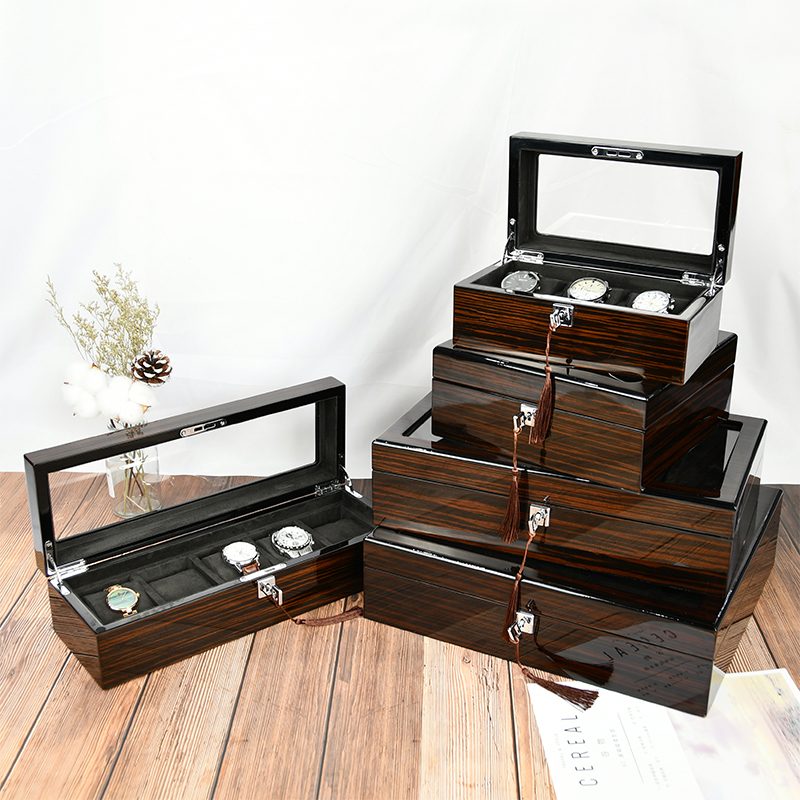
Ask ten buyers what they want and nine will name a colour. Colour, though, is the finish — the wood underneath is what gives a box its grain, its weight, its warmth in the hand and the way its surface behaves over years of use. Choosing the species is the decision that makes every later choice easier, because grain and tone set the limits of what a finish can achieve. This guide covers the species we build with, how they differ in practice, and how to match one to a product and a price tier.
Why species comes first and colour comes second
A lacquer can darken wood, brighten it, flatten it or make it gleam, but it cannot invent grain. Ask for a deep, oily figure with strong contrast and no species will supply it except the ones that already have it. Ask for a pale, quiet surface and a heavy dark timber will fight you all the way through production.
Species also fixes practical things that are hard to change later: how heavy the box feels, how well edges and hinges hold, how much the panel moves with humidity, and how a corner detail will read. That is why we settle the species in the 3D digital proofing stage, alongside structure — see how that fits into the wider custom packaging process.
What actually varies between species
| Grain | From straight and quiet to wildly figured. Grain is the single most visible difference and the hardest to fake. |
|---|---|
| Tone | Warm browns, red-browns, pale creams and near-blacks. Tone sets the palette the finish will work within. |
| Hardness | Denser species resist dents at corners and edges and hold fine details more crisply. |
| Stability | Some species move more with humidity than others, which matters for tight lid-to-base fits. |
| Weight | Dense timbers give a heavier, more substantial object; lighter species feel easier to carry and ship. |
| Workability | Hard species take engraving and sharp radii well; softer species are more forgiving to machine but mark more easily. |
Walnut: the modern default
Walnut is the species most buyers land on, and for good reason. It has a warm, chocolate-brown tone and a defined but not loud grain, it machines cleanly, and it sits comfortably between formal and contemporary — which is why it reads as modern luxury rather than antique. It takes a matte or satin finish beautifully and holds a brown-black lacquer well when a deeper tone is wanted.
Practical note: walnut is soft enough to mark if a box is thrown into a travel bag unprotected, and hard enough to hold its corners in normal handling. For watch boxes, jewellery chests and gift trunks it is a safe, versatile choice.
Rosewood: warmth and figure
Rosewood brings a reddish brown tone with strong, expressive figure and fine texture. It is denser than walnut and takes an excellent polish, which is why it has such a long association with musical instruments and formal furniture — and why it looks convincing on a collector's case or a single high-end watch box.
Because the grain is so pronounced, rosewood works best where it is allowed to be the feature: a large, uninterrupted lid panel, a book-matched top, or a surface with restrained hardware. Cover it in busy inlay or heavy hardware and the two effects compete. If you want warmth without the red cast, a warm-brown walnut with a satin finish will usually get you closer to the look than a rosewood with a correcting lacquer.
Maple and the pale timbers: light without looking cheap
Maple and similar pale hardwoods give a clean, tight, almost even grain and a cream-to-honey tone that makes them the natural choice for light interiors — a bright watch box with a cream lining, a jewellery tray set, a bridal piece. Pale wood is unforgiving in one specific way: it shows every dent and every smear of filler, so the sanding and preparation behind the finish has to be genuinely good rather than merely adequate.
Pale timbers also take colour differently from dark ones. A tinted clear coat will shift maple dramatically while barely moving walnut, so if you are matching a brand colour across a range, test the tint on the actual species in the 3D proof and on the physical sample, not on a screenshot.
Ebony and the dark species: statement surfaces
Ebony and other dense near-black timbers give the darkest surface available from wood alone — deep, fine-grained and formal, with very little visible variation. In a gloss finish they read almost like polished stone; under matte they become quiet and architectural. They are the natural choice when a box should feel weighty and restrained, or when brand hardware in gold or brass needs a dark surface to sit against.
The trade-offs are weight and workability. Dense dark species are heavier and harder on tooling, so fine details and sharp radii cost more production attention — but they also hold those details better than any soft species will. For a single hero piece rather than a long retail run, that is usually the right trade.
Solid wood versus veneer over engineered panel
Both are legitimate, and the honest answer is that the right one depends on the box. Solid timber gives a heavier hand, edges that can be shaped and rounded, and a warmth that is difficult to imitate. It can also move slightly with humidity, which is why solid-wood boxes are usually built with panels that are allowed to move rather than locked rigidly at every point.
A veneer over an engineered panel gives a flatter, more dimensionally stable surface and lets you use a species that would be impractical in solid form at the required thickness — a figured rosewood or an exotic burr, for example. It is also the more consistent option across a large order, because the substrate behaves identically from unit to unit. Which one is right depends on whether the brief is chasing weight and craft, or flatness and repeatability; on our custom wooden boxes page the two approaches are presented side by side.
How the finish changes everything you just chose
Two identical walnut panels can leave the workshop looking like two different species, depending on the finish. A high-gloss piano lacquer deepens the tone, lifts the figure and creates a mirror surface that reflects the room — dramatic, formal, and unforgiving of handling marks. A matte finish keeps the wood's natural colour, softens the grain contrast and hides fingerprints, which is why it is so often the better choice for anything that will be picked up and opened repeatedly.
Between those two extremes sits everything else: satin sheens, tinted clears, open-pore finishes that leave the grain texture visible, and solid colours that cover the wood entirely. If a range combines lacquered and wood-look pieces, choose one finish family and hold it across the range — mixed sheens are the fastest way to make a coordinated collection look accidental.
Matching species to product and price tier
A practical route, arrived at by product rather than by preference:
| Single hero piece | A dense, figured species — rosewood or ebony — with shaped edges and visible grain. Weight is an asset here. |
|---|---|
| Retail watch or jewellery range | Walnut, in matte or satin, with consistent grain direction and colour tolerance agreed up front. |
| Light and bridal lines | Maple or another pale hardwood with a cream lining, using tinted clears to shift the tone rather than dark stains. |
| Large sets and gift programmes | Veneer over engineered panel for flatness and repeatability, dressed with hardware and lining that carry the perceived quality. |
| Corporate and volume gifts | A stable species or veneer with a durable matte finish and restrained grain, so the logo and structure lead. |
What to settle before sampling
Bring four things to the brief and the sample will land close to the mark. First, the species or the look you are chasing, with a reference image. Second, the finish family — gloss, satin or matte — and whether the wood's own colour should stay visible or be shifted. Third, how the box will be used: handled daily, stored on a shelf, shipped loose, or displayed in a lit case. Fourth, the interior, since a cream lining on a dark species is a completely different object from the same box lined in black.
Sampling takes about 15 days and includes 3D digital proofing plus 2 rounds of revisions, which is enough room to test a species and finish combination before committing a batch — our packaging sampling guide walks through the stage in detail. If you would rather start from something you can hold, our 100+ ready-to-ship designs across the Tancy line and the wider wooden range let you evaluate grain, weight and finish before a custom run. Structure and hardware decisions such as lid type and hinge position are covered on the custom rigid boxes page.
There is no single best species — it depends on the look and the job. Walnut is the versatile modern default for watch boxes and jewellery chests; rosewood gives warmth and strong figure for hero pieces; maple and pale hardwoods suit light interiors and bridal lines; ebony and dark dense species give a formal, weighty near-black surface. We confirm the species and finish in the 3D digital proof before sampling.
Solid timber gives more weight, warmer edges and a more substantial hand. A veneer over an engineered panel gives a flatter, more dimensionally stable surface that behaves identically from unit to unit — which is usually better for large, colour-critical orders and for species that would be impractical in solid form at the required thickness. Both are built in our factory; the right choice depends on whether the brief prioritises weight and craft or flatness and consistency.
A high-gloss lacquer deepens the tone, lifts the grain figure and creates a mirror surface, while a matte finish keeps the wood's natural colour and hides fingerprints. Tinted clears shift pale species such as maple more than dark species such as walnut, so colour matching should be tested on the actual species rather than on screen. Finish family is confirmed on the physical sample.
Custom OEM and ODM wooden boxes start at 500 pcs per design, because panels, grain matching and finish are set up for your specification. Ready-to-ship designs start from 50 units per design. Sampling takes about 15 days with 3D digital proofing and 2 rounds of revisions; mass production takes about 30 days after order confirmation. Payment is by T/T with a 30% deposit and the 70% balance before shipment, shipping EXW or FOB Guangzhou, with DHL, FedEx and UPS available for express volumes.