Box Hinges, Locks and Hardware: Choosing Fittings for Wooden and Leather Boxes
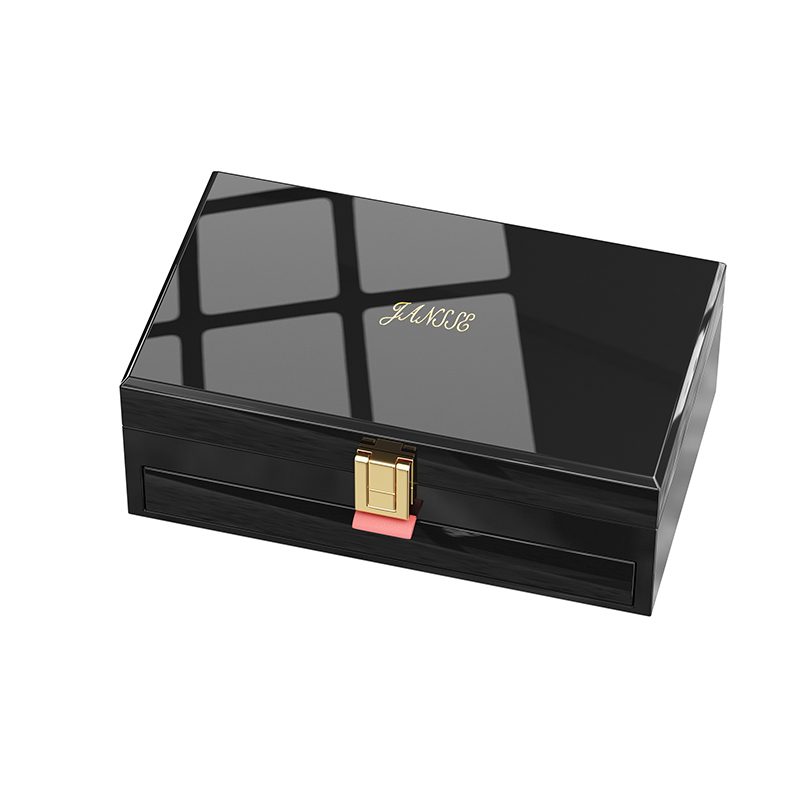
A wooden or leather box is judged in the first five seconds — and in those five seconds the buyer's hands are on the hardware. The hinge that lets the lid settle open, the turn lock that snaps shut, the metal finish held against a lacquered surface: these are the parts that tell someone whether the object in their hands is a serious box or a dressed-up container. Yet hardware is usually the last thing specified in a packaging brief and the first thing that goes wrong. This guide covers the fittings we build with, how each type behaves under daily handling, and how to write them into a specification so the finished box behaves the way it looks.
Why hardware carries more weight than buyers expect
Structure and finish decide how a box looks from a metre away. Hardware decides what it feels like in the hand — and the hand is where the decision is actually made, in a boutique, at a trade show counter, or in the first ten seconds of an unboxing. A hinge with too much play lets the lid wobble. A lock that needs two hands to close turns a premium object into a fumbling one. A bright polished clasp on warm rosewood fights everything around it.
Hardware is also the part of a box that wears first. Plating dulls at the contact points, springs soften and finishes scuff long before wood or leather shows any sign of age. That asymmetry is why we treat fittings as a structural decision rather than a styling detail — and why they are worth confirming on the sample instead of after mass production.
The four hardware families at a glance
| Hinges | Connect lid to base. Butt hinges, concealed hinges and continuous (piano) hinges each distribute load differently. |
|---|---|
| Locks and clasps | Hold the box closed. Turn locks, cam locks, push-button clasps, drawbolts and combination locks. |
| Lid supports | Ribbons, lid stays and friction hinges that stop the lid swinging back too far. |
| Decorative fittings | Corner protectors, nameplates, feet, metal edge trim and brand plaques. |
Hinges: the joint that defines how the lid moves
Butt hinges are the classic choice on wooden boxes: two leaves joined by a pin, mortised into the side wall so the metal sits nearly flush when the lid is closed. They are strong, replaceable and read as traditional — the right answer for collector cases and heavier lids.
Continuous, or piano, hinges run the full width of the lid. They spread load along the entire edge, which is what a long box or a glass-panelled lid needs. The trade-off is visibility: the knuckle stays on show, so the hinge becomes part of the design language rather than hidden joinery.
Concealed hinges keep the exterior surface uninterrupted, which suits leather-wrapped boxes where a mortise would break the wrap. They demand tighter tolerances, because there is no exposed metal to absorb small variations in lid fit.
Whichever family you choose, the detail that decides daily satisfaction is lid travel: how far the lid opens, and whether it stays where you put it. State the intended opening angle and whether the lid must hold itself open. Both are trivial to build in at design stage and awkward to retrofit later.
Locks and clasps: matching closure to use case
Turn locks are the most common closure on presentation boxes — a rotating latch that engages a catch on the lid. Flush-mounted, they sit almost level with the surface and close with one hand, which is why they dominate single-watch boxes and jewelry presentation cases.
Cam locks and push-button clasps trade some of that elegance for a firmer hold. They are the practical choice when a box will travel, be stacked, or be opened and closed dozens of times a day in a retail setting.
Drawbolts and combination locks push further towards security. A combination lock is the natural fit for multi-slot watch briefcases and high-value collector cases, where the box functions as a portable safe. If the contents carry real value, say so at briefing stage: the lock, the lining thickness behind it and the internal tray structure all have to be planned together.
Lid supports: the invisible decision
Two ribbons, one on each side, are the traditional way to stop a lid swinging past its intended angle. They are quiet, inexpensive and easy to replace. On heavier lids, a metal lid stay or a friction hinge does the same job with a more deliberate feel — the lid holds position part-way open, which is exactly what a retail display box needs.
The failure mode to avoid is a lid that falls open too far and stresses the hinge over months of use. When in doubt, open the question at sampling: changing a ribbon length on a sample is a five-minute conversation; reinforcing a hinge after 500 units are built is not.
Metal finish: the accent that sets the temperature of the box
Hardware finish does more for a box's perceived mood than any other single detail. Polished brass and gold-tone read warm and traditional. Nickel and chrome read cool and contemporary. Black oxide and gunmetal suit matte, technical products, while antique and brushed finishes carry a heritage feel.
Two practical rules. First, match the metal temperature to the material: warm metals over wood and warm lacquer, cooler metals over black, grey and cool lacquer. Second, specify the finish once and apply it everywhere — mismatched plating between hinge, lock and corner protector is the most common giveaway on an otherwise well-made box.
Hardware and structure: the tolerances that have to agree
Fittings and structure are not separate decisions. A mortised hinge needs wall thickness to sit in. A turn lock needs a lid thickness and a catch depth that line up. A glass lid changes how much weight the hinge must carry. A leather wrap adds a layer that can push an otherwise flush fitting proud of the surface.
This is why we confirm hardware in the 3D digital proof rather than leaving it to the workshop: at that stage the position, size and depth of every fitting can be checked against the structure before a single panel is machined. If surface finish is part of the same decision, our piano lacquer finish guide explains how the coating is built and how it behaves around hardware edges, and the logo finishing guide covers how branding sits on the same surface.
A hardware specification checklist
Send these lines with your brief and most of the hardware back-and-forth disappears:
- Hinge type — butt, concealed or continuous
- Lid travel — intended opening angle and whether the lid must hold position
- Closure type — turn lock, cam lock, push-button clasp, drawbolt or combination
- Metal finish — one finish family across every fitting
- Fitting positions — and whether hardware must sit flush or may stand proud
- Internal reinforcement — lining thickness behind locks and hinges
- Lid weight — glass, inlays and heavy panels change the hinge requirement
- Brand plaques — separate plate, engraved metal, or a logo applied directly to the wood or leather
- Feet and corner protection — needed or not, and in which finish
- Handling conditions — retail shelf, travel case or archival storage
How we build and verify fittings
Hardware is fitted late in our production flow — after woodworking, lacquering and wrap — which means it inherits every tolerance set upstream. Sampling takes about 15 days and includes 3D digital proofing plus 2 rounds of revisions, which is where lock engagement, hinge flushness and finish matching get confirmed. Mass production takes about 30 days, with each process inspected before moving to the next, and third-party inspection is welcome.
We have been manufacturing wooden and leather packaging in Guangzhou for 18 years and hold ISO 9001, FSC, CE, RoHS and REACH certifications. Custom orders start at 500 pcs per design, with payment by T/T (30% deposit, 70% before shipment) and shipment EXW or FOB Guangzhou, plus DHL, FedEx and UPS for smaller volumes.
If you would rather see how these fittings behave before committing to a custom run, browse our in-stock watch boxes — the Tancy line covers single-lid turn-lock boxes, multi-slot collector cases and combination-lock briefcases from 50 units. To build your own, start from custom wooden boxes, review the full capability list on our service page, or send your specification through the contact page — we reply within 24 hours.
Butt, concealed and continuous hinges; turn locks, cam locks, push-button clasps, drawbolts and combination locks; ribbon and metal lid supports; plus corner protectors, feet, edge trim and brand plaques. Hardware is confirmed in the 3D digital proof so its position and depth can be checked against the structure before production.
Yes. Polished brass, gold-tone, nickel, chrome, black oxide, gunmetal and antique or brushed finishes are available, and the same family is applied across hinge, lock and decorative fittings so the box reads as one piece. Finish and logo treatment are confirmed on the physical sample during the 15-day sampling process.
Custom OEM and ODM orders start at 500 pcs per design, because hinge mortising, lock catch depth and plating are all set up for your specification. If you want to evaluate hardware quality first, our 100+ ready-to-ship designs — including the Tancy watch-box line — start from 50 units per design.
Sampling takes about 15 days and includes 3D digital proofing plus 2 rounds of revisions. Mass production takes about 30 days after order confirmation. Payment is by T/T with a 30% deposit and the 70% balance before shipment; goods ship EXW or FOB Guangzhou, with DHL, FedEx and UPS available for express volumes.