Wooden Box Joinery: Mitre, Finger, Dovetail and Rabbet Joints Compared
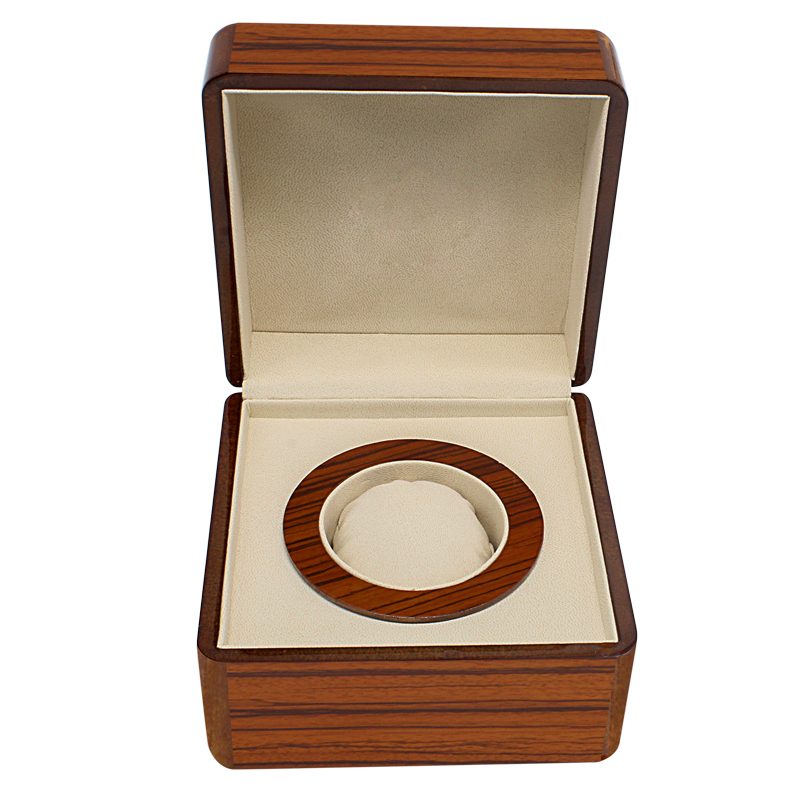
Pick up any rigid wooden box and look at the corners before anything else. The corners are where a box is made or revealed: they carry the grain direction, they take the knocks, they open when the wood moves, and they are the first place a finish cracks. Two boxes in the same wood, the same size and the same price can behave completely differently over five years, and the difference is usually which joint holds the corners together.
Joinery is not a detail of interest only to woodworkers. It decides how a box looks as it ages, how it survives shipping, what happens when the climate changes, and what a lacquer finish is allowed to do. This guide compares the four joints that matter in wooden packaging — mitre, finger, dovetail and rabbet — and what each one asks of the material and the buyer.
Why the corners decide everything
A box body is four sides and a top. The sides meet at eight corners, and every one of them is an edge where two pieces of wood agree or disagree. If they are cut to fit and joined under tension that matches the material, the box stays square; if the joint fights the wood, the wood wins eventually.
There is a reason corners fail and panels do not: a panel moves as one piece, but a corner joins two pieces moving at slightly different rates. That is why joint choice is really a question about wood movement — how much the material will change, and what the joint will do about it.
Mitre joints: the grain-matched look
A mitre joins two pieces at 45 degrees so the grain appears to run continuously around the corner. It is the presentation joint — the one that makes a small watch box or a jewellery case read as one seamless object, and the only one that lets a burl or a strong figure wrap the box without interruption.
The trade-off is that a mitre has almost no mechanical strength of its own: it is end grain glued to end grain, so everything depends on the glue and the accuracy of the cut. A mitre cut at 44.6 degrees on one side and 45.2 on the other shows as a visible line that no amount of sanding hides. Good mitres are CNC-cut for accuracy and often reinforced internally with a spline or a key, which trades a sliver of invisibility for a large gain in strength.
Finger joints: strength you can see
A finger joint — the interlocking box joint — cuts a row of complementary teeth so the two pieces mechanically lock into each other. Where a mitre is glue plus faith, a finger joint is geometry: even before the glue sets, the corner cannot fold.
The look is a deliberate signature row of squares along the corner, which suits natural-finish, open-grain and rustic retail pieces better than formal lacquered presentations. For structural boxes — shippers, heavy multi-bottle formats, storage that will be handled roughly — it is the honest choice: more glue surface, more mechanical lock, and a failure mode of denting rather than opening.
Dovetails: the drawer joint
Dovetails flare the fingers so the joint resists being pulled apart in one direction — which is exactly the load a drawer puts on its front every time it is opened. That is why dovetails belong to drawers, jewellery cabinets and any component that slides: the joint is strongest precisely along the axis of use.
In packaging, dovetails appear on premium storage: multi-drawer jewellery cabinets, watch storage with drawers under the main well, humidors. They are visible craftsmanship — buyers recognise them — and they cost more to cut and fit, so they are usually specified where the drawer will be opened daily for years.
Rabbets, dados and grooves: the invisible joints
Not every joint shows. A rabbet is a step cut into an edge so a panel sits flush inside it; a dado is a channel cut across a face so a shelf or divider slots in; a groove runs the length of a piece to carry a sliding lid. These joints carry panels, glass and internal dividers, and they do most of the structural work of a box without ever appearing on the outside.
Sliding-lid formats — common in tea, spirit and gift boxes — live or die by the groove: cut it too loose and the lid rattles and sheds dust, too tight and it binds when the wood swells. A glass lid seated in a rabbet, held by the frame rather than glued to the wood, can be replaced if it breaks — a detail worth specifying.
How the material changes the joint
Solid wood and MDF do not join the same way. Solid wood moves seasonally, so its joints have to allow for it; MDF is dimensionally stable and can be cut cleaner and glued harder, but it has no grain to celebrate — a finger joint in MDF is strong and meaningless, while in walnut it is a design feature. Veneered MDF gives a mitre the continuous-grain look without the solid-wood movement, which is why so many lacquered presentation boxes are built exactly that way.
The rule of thumb: the more visible the wood, the more the joint is a design decision; the more the box is wrapped, lacquered or lined, the more it is purely an engineering one.
From CNC to hand: how joints are actually made
In a production run, joints are cut, not carved. Boards are cut to size, shaped on CNC for the repeatable geometry — the mitres, the grooves, the finger patterns — then fine-sanded before finishing. The sequence matters as much as the cutting: primer, colour coats, controlled curing and polishing happen after the joinery, because a joint that moves after finishing takes the paint film with it.
Machines hold the tolerances; hands check the fit. Grain alignment across a corner, the evenness of a glue line, the way a drawer sits — those are eyes-on details, and they are why a box from a factory that inspects after every step looks tight a year later. Assembly is followed by hardware fitting, interior assembly, then final check and export packing.
Joinery and finish: why lacquer wants stable joints
A high-gloss piano lacquer finish is a built-up film, and a film is only as stable as what is underneath it. A mitre that opens by a hair after a dry winter shows as a hairline in the lacquer; a finger joint that flexes shows as a crazed line along every tooth. This is why lacquered boxes favour mitred corners on stable, wrapped or engineered bodies, and why makers who lacquer over mitres reinforce them.
Open finishes are more forgiving: oil and matte finishes move with the wood and make a shifting joint look like character. If a box is destined for a dry heated shop or long sea freight, that tolerance is worth asking about at the design stage rather than discovering on the shelf.
Choosing a joint: the short comparison
| Joint | Strength | Look | Best for |
|---|---|---|---|
| Mitre (45°) | Glue-dependent; reinforce it | Continuous grain, formal | Lacquered presentation boxes, veneered bodies |
| Finger / box | High, mechanical lock | Visible pattern, deliberate | Natural-finish boxes, heavy or handled formats |
| Dovetail | High along pull axis | Craft signature | Drawers, cabinets, storage opened daily |
| Rabbet / dado / groove | Structural, hidden | Invisible | Glass seats, sliding lids, dividers, shelves |
What to specify before sampling
You do not need to name the joint — you need to describe the use, and let the structure follow. Useful starting information: what the box holds and its weight, whether it will be opened daily or occasionally, whether it ships by sea, and how visible the wood should be. From that, the body and joint can be proposed, reviewed as a structural drawing and a 3D render, and confirmed in a physical sample.
Sampling takes about 15 days and includes 3D digital proofing plus two rounds of revision — use the sample to inspect the corners under raking light, because that is where fit shows. Production runs about 30 days after confirmation, with a check after every step before export packing. Custom programmes start at 500 pcs per design; enquiries are answered within 24 hours.
See custom wooden boxes for body options, custom rigid boxes for wrapped and engineered formats, our solid wood vs veneer guide for how the body material is chosen, and contact us to start a specification.
Finger joints and dovetails have mechanical strength — the interlocking geometry holds even before glue sets, and dovetails resist pulling along one axis, which is why they suit drawers. Mitre joints are glue-dependent and usually reinforced with a spline. In small presentation boxes the loads are light, so cut accuracy and glue quality matter more than brute strength.
Yes, and most well-designed boxes do. A mitred body with a dovetailed drawer, a sliding lid in a groove and a glass panel seated in a rabbet is one common combination — each joint doing the specific job it is best at.
MDF is dimensionally stable and can be cut cleaner and glued harder than solid wood, but it has no grain to show. That is why visible finger joints and dovetails belong to solid wood, while veneered MDF is usually mitred to get the continuous-grain look without solid-wood movement.
A structural drawing and 3D render at the design stage, then a physical sample — sampling takes about 15 days with 3D digital proofing and two revision rounds. Inspect the sample corners under raking light: that is where cut accuracy and fit show. Production runs about 30 days after confirmation, with a check after every step.