Jewelry Box Materials: Wood, Veneer, Lacquer, Leather and PU Compared
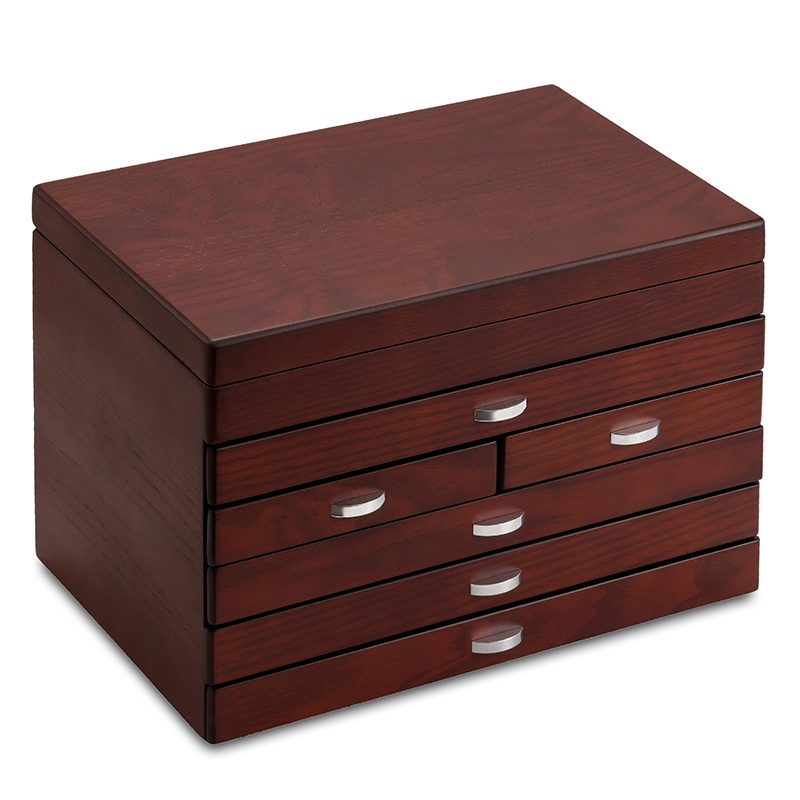
Ask a buyer to describe the jewelry box they want and the answer almost always comes back as a look — warm, dark, soft, minimal. The look is the output, not the input. What produces it is a material decision, and on a jewelry box that decision runs deeper than on most packaging, because the exterior, the interior lining, the branding method and the weight of the finished piece all follow from it.
This guide compares the four material families a jewelry box is actually built from — solid wood and veneer, lacquered engineered panel, leather, and PU — with what each one gives you, what it costs you later, and which products it suits. It is written for buyers specifying a custom programme.
Why material comes before design
Material is not a finish you apply at the end; it determines what can be built. Solid wood and veneer can be shaped, joined and polished, and take a logo by foil or laser. A lacquered panel takes a mirror surface that no natural timber can match, but the surface is a coating and behaves like one. Leather wraps a rigid body in a soft surface and changes the hand-feel completely. Each of those materials implies a different structure, a different interior and a different branding method — so choosing late means amending everything that was already decided.
For context on the range these materials serve, start from custom jewelry boxes.
Solid wood and veneer: the natural option
Solid wood is the reference standard. It takes a fine edge, holds a joint, accepts oil or lacquer, and ages — a walnut or rosewood box looks better after a decade than on the day it was made. It is also the most variable: grain, colour and movement differ board to board, which is why the finest one-off pieces command the longest production time.
Wood veneer over an engineered panel exists to solve that variability. A thin layer of real timber laid over a stable substrate gives consistent grain and colour across a run of hundreds, with far less movement than solid stock. For a programme where every box must match the next, veneer is usually the right body. Species choices and what they actually change are covered in choosing wood for a premium box, and the construction trade-off in custom wooden boxes.
Lacquered panel: mirror, colour and consistency
Where a natural surface cannot go, lacquer can. A high-gloss piano finish over MDF produces a true mirror — the surface that makes a fuchsia or navy jewelry box read as a statement piece rather than a container. Matte lacquer gives the opposite effect: modern, restrained, and far more forgiving of fingerprints and handling.
The trade-off is that lacquer is a coating on a substrate, so a deep chip cannot be sanded out the way a mark in solid timber can, and a colour must be matched batch to batch. That is why lacquer boxes are specified with a colour reference and approved on a physical sample rather than a screen. The layer-by-layer process is described in how a piano lacquer finish is built.
Leather and PU: the soft option
Wrapping a rigid body in leather moves a jewelry box into a different category of object — softer to hold, quieter to close, warmer in the hand. Genuine leather brings grain, patina and a corner that can be wrapped by hand into a clean, tight edge; that wrapped corner is where a leather box is judged. PU is the engineered alternative: consistent colour and texture across a large run, uniform from box to box, and easier to keep identical on a repeat order.
Both wrap the same substrate, so the body beneath matters as much as the surface: a rigid panel keeps the box square and the lid true. The full comparison is in PU versus genuine leather for packaging boxes, and the formats in custom leather boxes.
What the exterior decides about the interior
Jewelry boxes are judged open, which means the interior is half the product. Velvet and suede are the standard linings: velvet for a formal, light-catching presentation, suede for a softer, more contemporary hand. Moulded EVA and shaped foam are used where the item needs to be held in a precise position rather than laid in a compartment — rings and pendants especially.
The lining has to agree with the exterior. A leather-wrapped box with a velvet interior reads as a jeweller's case; the same box lined in suede reads as a travel piece. Colour contrast matters too — a dark exterior with a pale lining makes small items visible the moment the lid opens, which is a functional point, not only a styling one. Interior material choices are compared in jewelry box inserts.
Branding: what each material will accept
Not every logo method works on every surface, and this is the most common specification mistake. Hot foil gives crisp, bright results on lacquer and smooth grain, and is the default for gloss boxes. Screen printing suits flat lacquer and larger marks. Debossing presses into leather and PU and reads as quiet confidence. Laser marking suits natural timber and matte finishes where foil would look applied.
Decide the method alongside the material, not after it — a leather wrap chosen after a foil stamp was specified means re-planning the mark. Metal plaques are the exception: they can be fitted to wood, leather or lacquer alike, which makes them useful when the programme spans several materials.
Weight, freight and the costs that arrive later
A jewelry box is shipped, stacked and handled before it is ever given as a gift, and material decides how well it survives that. Solid wood is heavy and bulky, which raises freight cost per unit and suits premium pieces where weight reads as value. Veneer and lacquered panel reduce weight while keeping a rigid feel, and suit retail ranges shipped in quantity. Leather-wrapped boxes sit in between, with the advantage of a surface that hides the scuffs of handling better than gloss lacquer.
Durability across a long life points the same way: a solid wood or leather box absorbs marks and keeps looking intentional; a high-gloss surface shows every one. If the boxes will travel through a distribution chain before reaching a customer, say so when you brief — it should influence the finish choice.
Matching material to product type
Different jewelry pushes the decision different ways. The table below is a starting point, not a rule — the brand's own language always wins.
| Product | Materials that suit it | Why |
|---|---|---|
| Rings and single-stone pieces | Lacquered panel, leather wrap | Small format; the surface carries the impression, insert holds the piece upright |
| Necklaces and pendants | Veneer, solid wood, leather wrap | Needs length and a channel or hook; rigid body keeps the chain from tangling |
| Earrings and pairs | Lacquered panel, PU wrap | Paired cavities on a small footprint; consistency across a run matters most |
| Sets and multi-piece gifts | Solid wood, veneer | Larger footprint where grain and weight read as value |
| Storage chests and cabinets | Solid wood, veneer | Built to be lived with for years; drawers and tiers need a stable body |
Specifying material before sampling
Go into sampling with the material decision made, or at least narrowed to two options. Sampling takes about 15 days and includes 3D digital proofing plus two rounds of revision — enough time to compare two directions, not enough to explore six. The practical approach is to settle the family at the brief stage — wood, lacquer or leather — and use the physical sample to settle the detail: species, colour, grain direction, lining and logo method.
Custom programmes start at 500 pieces per design, with production running about 30 days after sample approval. FSC-certified wood sourcing is available alongside ISO 9001, CE, RoHS and REACH certifications. Send your product sizes, quantities and material direction to request a quotation, or see how programmes are run on the service page.
Solid wood is the reference standard — it takes a fine edge, holds a joint and ages well — but grain and colour vary board to board. Wood veneer over an engineered panel gives consistent grain and colour across a production run with less movement, which is usually the right body for programmes of hundreds. Species such as walnut, rosewood and ebony are chosen for colour and figure.
Yes. A leather or PU wrap over a rigid body keeps the box square and the lid true, and the surface hides scuffs better than high-gloss lacquer. Genuine leather brings grain and patina and a hand-wrapped corner; PU brings colour consistency across a large run and uniformity on repeat orders.
500 pieces per design. Sampling takes about 15 days and includes 3D digital proofing plus two rounds of revision; production runs about 30 days after sample approval. FSC-certified wood sourcing is available, and ISO 9001, CE, RoHS and REACH certifications are held.
Yes — mixing is common, for example a lacquered body with a leather-wrapped lid, or a veneer exterior with a contrasting interior lining. Decide the mix at the brief stage, because the branding method has to suit the surface: hot foil for lacquer and smooth grain, debossing for leather and PU, laser marking for natural timber and matte finishes.