Watch Storage Boxes by Capacity: From a Single Watch to a 48-Piece Collection
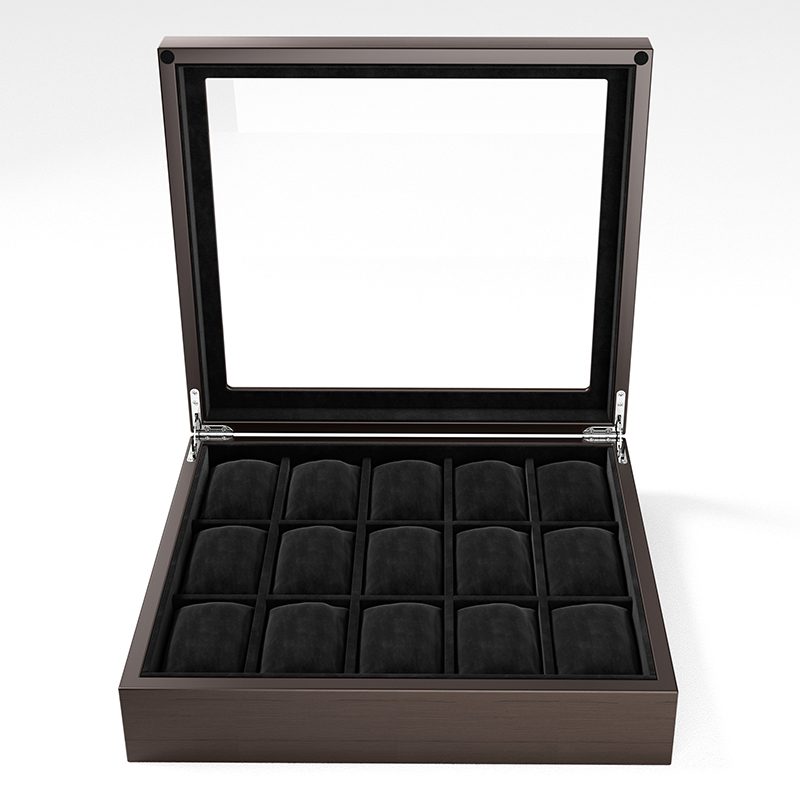
Every watch storage decision starts with the same question: how many watches does this box need to hold, now and two years from now? Answer it wrong in either direction and the box fails. Too small, and the collection outgrows it within a season. Too large, and half-empty slots make a good collection look sparse — and a retailer look underbought.
Capacity sounds like the simplest specification on a watch box, but it drives the format, the footprint, the interior engineering and the price tier. This guide walks through the capacity ladder from single-watch boxes to collector cabinets, what each size range is actually for, and how to choose between ready-to-ship formats and a custom build.
Why capacity comes before format
Slot count is the one decision that cannot be revised later. Material, finish and lining can all be swapped at the sampling stage, but a box built for six watches will never hold ten. That is why capacity is the first line of any specification — before dimensions, before material, before finish.
Capacity also decides the shape. One to three watches suit a compact box, a roll or a zippered case. Six to twelve suit the classic rectangular chest. Beyond fifteen, you are in cabinet territory — drawers, trays and lockable doors. Choose the count and the format largely chooses itself.
Single to three slots: gifts and daily rotation
A single-watch box is the workhorse of the industry. Watch brands ship product in it, and it is the default gift box. Two- and three-slot boxes serve the collector who rotates a small daily set, and the traveller who wants a second watch on the road — though for pure travel use, a leather roll or zippered case usually wins on bulk, as covered in our watch travel case guide.
At this end of the ladder the box is as much presentation as storage. Lacquered wood, a contrast lining and a well-fitted pillow do more for a single watch than for any larger format, because there is nothing else to look at.
Five to twelve slots: the collector's sweet spot
The six-to-twelve range is where most serious buyers land. A 5- or 6-slot box holds a working collection; a 10- or 12-slot box holds a collection with room to grow — and that headroom is the point. Collectors buy watches; a box filled to its last slot on day one is a purchase regret within a year.
This is also the range where the glass lid earns its keep. A closed box is storage; a glass-lid box is a display. For a desk or a dresser top, the ability to see the collection without opening the lid is the feature owners use daily. In-stock ranges cover this territory densely — 5, 6, 8, 10 and 12 slots in wood, lacquer and leather are all standard formats, which is why the in-stock watch boxes range concentrates here.
Fifteen slots and up: cabinets and briefcases
Past fifteen slots the box becomes furniture. A 15-slot glass-lid chest is the upper limit of the dresser-top format; beyond that, multi-tier cabinets with drawers and double doors take over, up to 48-piece briefcase-style cases for dealers and collectors who transport stock.
At this scale the engineering questions change. Slot pitch and lid clearance matter more because a miscut is multiplied across dozens of positions — the dimensional logic is covered in our watch box sizing guide. Weight becomes a freight issue. And hardware graduates from decorative to functional: locks, keyed latches and reinforced hinges are no longer optional.
Fixed slots or removable cushions
Two interior philosophies run across every capacity. Fixed slots with fitted pillows give a precise, repeatable presentation — every watch sits identically, which is what a retailer or a brand programme wants. Removable cushions give flexibility: pull a cushion and a slot holds cufflinks, a strap or a piece of jewelry instead.
For a personal collection, removable cushions usually win because collections change. For a brand shipping product, fixed interiors win because consistency across thousands of units is the whole point. The pillow and lining options behind both approaches are covered in our watch box interior guide.
In-stock or custom: two routes to the same shelf
In-stock boxes — our Tancy range covers 100+ styles with a minimum order of 50 pieces — answer speed and small quantity. The formats on the ladder above are all proven, photographed and ready. For a retailer building a first assortment or a brand testing the market, stock boxes are the low-risk route.
Custom answers everything stock cannot: an unusual slot count, a branded interior, a mixed layout of watches and straps, or a capacity built around a specific collection plan. Custom programmes start at 500 pieces per design, with sampling in about 15 days — including 3D digital proofing and two rounds of revision — and production in about 30 days after sample approval. The full range of what can be built sits under custom watch boxes.
A capacity checklist before you order
Five questions settle capacity for almost every buyer:
| Question | Why it matters |
|---|---|
| How many watches today? | Sets the floor — the minimum slot count |
| How many in two years? | Sets the ceiling — buy for the collection you will have |
| Display or storage? | Decides glass lid versus closed top |
| Personal or programme? | Decides removable cushions versus fixed interiors |
| Quantity needed? | Under 500 points to in-stock; 500+ opens custom |
Answer these and the format, the interior philosophy and the buying route follow automatically. What remains is the enjoyable part: material, finish and lining.
Buy for the collection you will have in two years, not the one you have today. Most collectors land in the 6 to 12-slot range: a 10 or 12-slot box holds a working collection with headroom, and a box filled to its last slot on day one is usually outgrown within a year.
In-stock boxes — the Tancy range covers 100+ styles from a 50-piece minimum — are proven formats that are ready to order, ideal for retailers and market tests. Custom programmes start at 500 pieces per design and answer anything stock cannot: unusual slot counts, branded interiors or mixed watch-and-strap layouts.
Sampling takes about 15 days and includes 3D digital proofing plus two rounds of revision. Production runs about 30 days after sample approval. Shipments leave EXW or FOB Guangzhou, with DHL, FedEx and UPS express options for smaller orders, and enquiries are answered within 24 hours.
For a personal collection, removable cushions usually win — pull one out and a slot holds straps, cufflinks or jewelry as the collection changes. For a brand programme, fixed interiors win because every unit presents the watch identically across thousands of boxes.