Why Wooden Boxes Warp: Moisture, Drying and How Manufacturers Prevent It
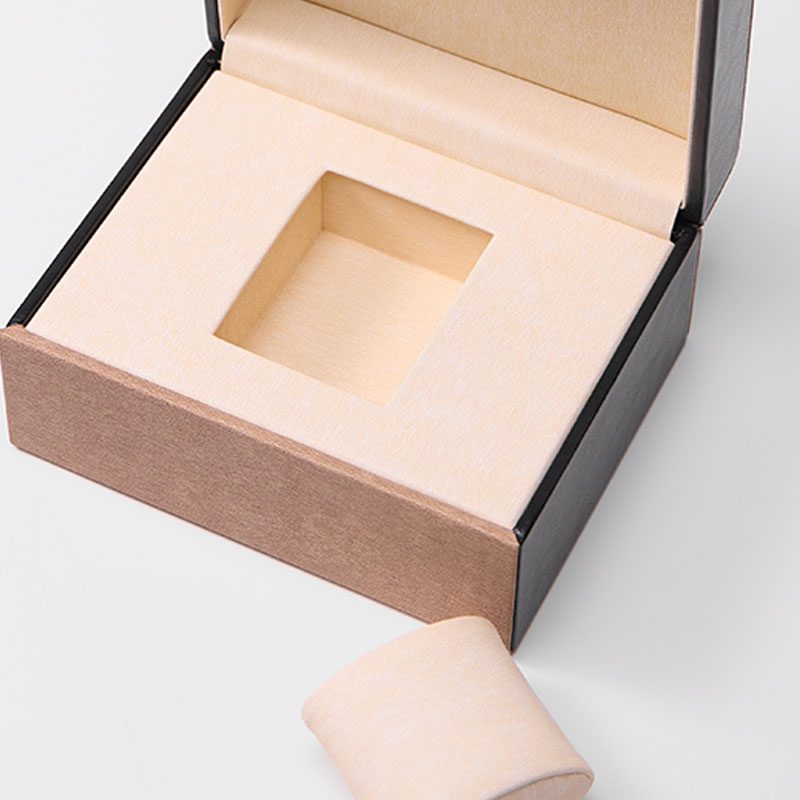
A warped wooden box announces itself quietly. The lid that met its base flush at the factory now rocks on a corner. A door that closed with a soft click now rubs. Nothing broke — the wood simply moved, and it moved because of water. Understanding why is the difference between specifying a box that stays true for decades and one that disappoints within a season.
This guide explains the mechanics of wood movement in plain terms, what a manufacturer does at each production stage to keep a box stable, and what a buyer can check before approving a sample or accepting a shipment.
Wood never stops moving
Wood is hygroscopic: it takes on moisture from humid air and releases it into dry air, and it swells and shrinks as it does. Critically, it does not move equally in all directions — it moves far more across the grain than along it. A wide lid panel can change measurably in width with the seasons while its length barely changes at all.
This is not a defect in the material; it is the nature of it. The goal of good manufacturing is not to stop movement — nothing can — but to control it: to start with stable material, to build in ways that accommodate movement, and to seal the surface so change happens slowly and evenly.
It starts with drying
Stability is decided before a single cut is made. Timber that goes into production carrying excess moisture will shed that moisture later — inside a finished box, where the result is shrinkage, gaps and warp. That is why serious production begins with kiln drying and conditioning: wood is dried to a stable moisture content and then held there so the material is in equilibrium before machining begins.
Moisture control is not a one-time event, either. Dried timber stored in a damp warehouse re-absorbs moisture, which is why material storage and workshop conditions matter as much as the kiln. A box factory that takes stability seriously manages moisture as a chain — drying, storage, machining, finishing — not as a single step.
Construction: designing for movement
The second line of defence is how the box is built. A wide panel fixed rigidly on all four sides has nowhere to go when it wants to move — so it cups or splits. Experienced construction anticipates this: panels are given room to move, joints are chosen for the loads they will carry, and grain direction is considered across adjoining parts so components move together rather than against each other.
This is where the choice between solid wood and veneer over an engineered panel becomes a stability decision as much as a cost one. An engineered core moves far less than solid timber, which is why veneer construction dominates large, flat surfaces like lids — the trade-offs are covered in our solid wood versus veneer guide. Joint selection plays a role too, and our wooden box joinery guide covers how mitre, finger and dovetail joints behave under stress.
Finishing: sealing the surface
A finish does more than create sheen — it is a moisture barrier. Lacquer, in particular, seals the wood surface and slows the exchange of moisture between the timber and the air. Slowing that exchange is what matters: wood that takes on moisture gradually and evenly stays flat; wood that takes it on quickly and unevenly cups.
This is why a finish must be complete to do its job. The inside of a lid, the underside of a base, the interior faces nobody sees — if these are left raw while the show surfaces are sealed, moisture enters unevenly and the panel moves unevenly. A properly finished box is sealed all round, seen and unseen. The layered build-up of a sealed surface is covered in our piano lacquer finish guide.
Where craft carries the last mile
Machines do the precision — CNC cutting, consistent panel thickness, repeatable joinery. But stability is finished by hand: grain matched so adjoining panels read as one surface, edges eased so the finish film is continuous around every corner, hinges set so a lid hangs true without binding. At our factory the split is deliberate — machines for accuracy, hands for the judgement calls — and around 70% of our production team have worked together for over ten years, which means the people fitting your lid have fitted thousands like it.
The production sequence itself is built around stability: cutting and CNC forming, fine sanding, primer, colour coats, temperature-controlled curing, polishing, hardware fitting, interior assembly and final inspection — ten stages, each one signed off before the next begins.
What buyers can check
You do not need a moisture meter to audit a box for stability. Five checks at sample stage tell you most of what matters:
| Check | What it tells you |
|---|---|
| Lid meets base flush on all sides | Panel is flat and hinges are true |
| Box sits without rocking on a flat surface | Base has not cupped |
| Inside faces and underside are finished | Moisture exchange is slowed evenly |
| Grain direction is consistent across panels | Parts will move together, not against each other |
| Joints are tight, with no daylight at corners | Fit was right at equilibrium moisture |
Repeat the same checks when a bulk shipment arrives, ideally after the boxes have acclimatised to your warehouse for a few days. Every order we ship passes per-stage quality inspection before it leaves, and third-party inspection such as SGS is welcome — but a buyer who knows what to look at is the best last line of defence. For a fuller receiving routine, see our packaging QC inspection guide.
Specifying stability into your order
Stability is a specification, not a hope. When you brief a custom wooden box programme, ask three questions: how the timber is dried and conditioned, whether wide panels are solid or engineered, and how the inside faces are finished. A manufacturer with clear answers has a process; one without them has a risk.
Custom programmes start at 500 pieces per design, sampling runs about 15 days with 3D digital proofing and two rounds of revision, and production runs about 30 days after sample approval. FSC-certified wood sourcing is available, and the factory holds ISO 9001, CE, RoHS and REACH certifications — a useful frame, because stability is ultimately a quality-system outcome, not a single craftsman's promise.
Wood is hygroscopic — it absorbs and releases moisture with the air, swelling and shrinking as it does, and it moves far more across the grain than along it. A box warps when that movement is fast or uneven: usually because the timber was not fully dried, the panel was fixed without room to move, or only the visible faces were sealed.
Three lines of defence: kiln drying and conditioning so timber enters production at a stable moisture content; construction that gives panels room to move and matches grain direction across parts; and a complete finish — including inside faces and undersides — that slows moisture exchange evenly.
Yes, for large flat surfaces. An engineered core moves far less with humidity than solid timber, which is why veneer over engineered panel dominates wide lids. Solid wood remains the reference for presence and ageing, but it demands more from drying and construction to stay true.
Five quick checks: the lid meets the base flush on all sides; the box sits without rocking on a flat surface; inside faces and the underside are finished, not raw; grain direction is consistent across adjoining panels; and joints are tight with no daylight at corners. Repeat them after the shipment has acclimatised in your warehouse.